State of Play: A Sense-Check for November 2026
Every now and then I like to stop and check where things are at. What's changed, what hasn't, and what I'd bet on from here.
This is that check for November 2026. I've split it into four parts: social, technological, economic and political. Strategists call this a PEST analysis (political, economic, social, technological). I'm going in a different order, but it's the same idea.
Some of this is about VR, and most of it is a lot bigger than VR. I'll be clear about which bits are numbers and which bits are my opinion.
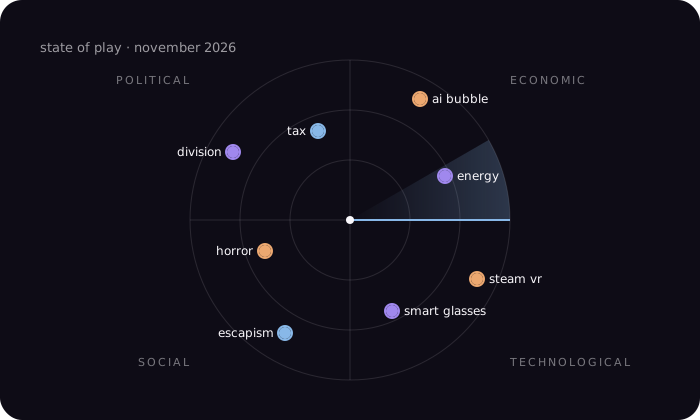
Note: Everything here is as of 3 November 2026, and prices are in US dollars. The numbers have sources at the bottom. The forecasts are mine, so take them with a pinch of salt.
Social
Checking Out
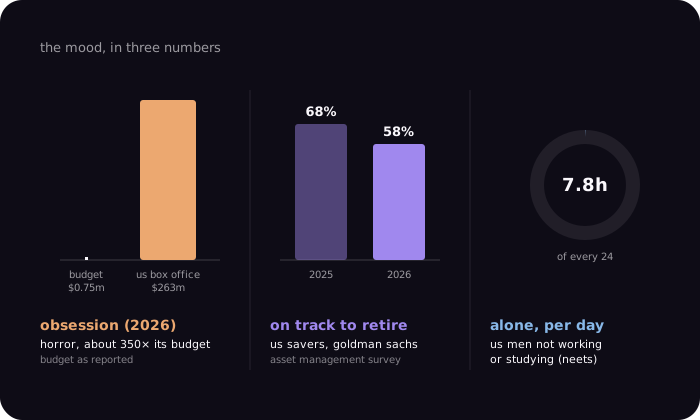
Young people are disengaging, and escapism is growing. An analysis of the American Time Use Survey, published in February, looked at young people who aren't working or studying (NEETs). They spend about 2.6 hours a day watching TV and 1.6 hours gaming. NEET men spend an average of 7.8 hours a day alone.
Older people are revising their plans too. In Goldman Sachs Asset Management's survey, 58% of American savers said they were on track for retirement this year, down from 68% a year earlier. In a survey by Economist Enterprise and Nuveen, about half of full-time workers said the cost of living was keeping them from retiring on time, by about four years on average. At least for now, a lot of people are planning to work longer.
Social Media
Social media still runs the conversation, at least on the English-speaking internet. It splits opinion, and I think it's wrecking our ability to work out what's true together. Everyone gets their own feed, their own facts and their own villains. More on who benefits from that under Political.
Art Got Bleak
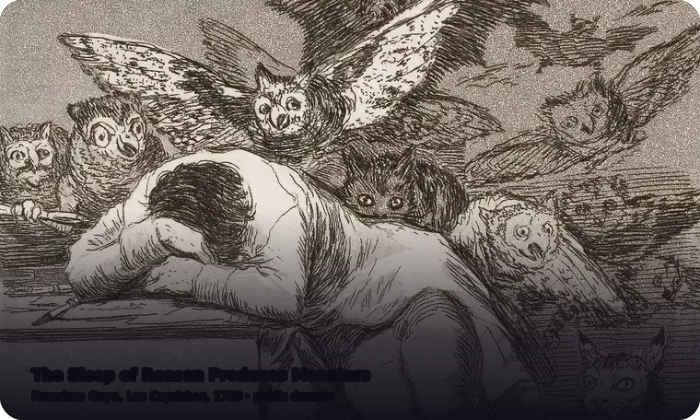
Art has turned ugly and bleak, and the box office shows it.
The year's biggest films overall are still the franchises: Spider-Man: Brand New Day, The Odyssey and Michael. But horror is having its biggest run ever. Blumhouse's Obsession reportedly cost $750,000 to make and has taken $263 million in the US alone, about 350 times its budget. Backrooms and Resident Evil are both up there too. By 9 October, horror had taken about $1.3 billion at the US box office, closing in on last year's record of $1.4 billion.
I think that reflects the fear and discomfort a lot of people feel right now.
Music Went Two Ways
Music is split. One half is escapism. Spotify's summer forecast leaned on what it called "postcard country", like Ella Langley's "Choosin' Texas", Kacey Musgraves' "Mexico Honey" and Noah Kahan's "Doors". Country is doing nostalgia, and a lot of pop is doing blissful ignorance.
The other half is harder and angrier. Spotify predicted harder, more aggressive dance music would go mainstream this year, and launched a playlist called GRAVEL for it. Hardstyle is booming. And according to Spotify, the most popular hip-hop subgenre among 18 to 24-year-olds is Russian phonk, ahead of trap metal and rage rap. It's frantic, distorted music, and I read all of that as disenchantment with how things are.
Technological
The Singularity Is Here
I've been writing about the singularity for a while. I think it's here. Humans are out of the loop more and more.
Ask the mathematicians. In May, OpenAI said one of its models had disproved the unit distance conjecture, a geometry problem from Paul Erdős that's been open for about 80 years. OpenAI asked mathematicians including Timothy Gowers, Daniel Litt and Will Sawin to check the proof. It held up. Gowers said no previous AI-generated proof had come close to the standard of top journals. It took some human work to clean up, but the mathematicians' job was mostly to verify.

Open Source and DIY
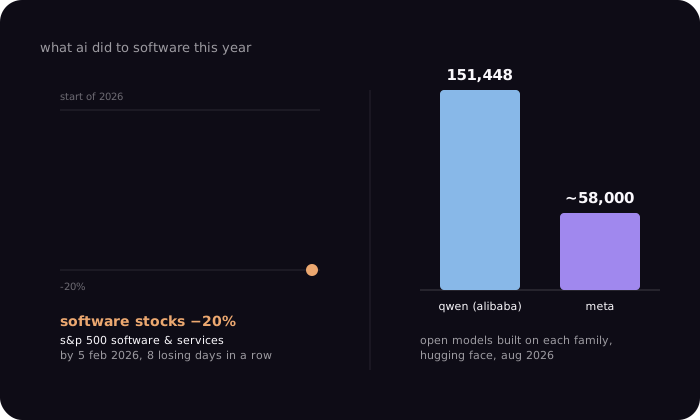
Open source is booming. Hugging Face's summer report counted around 2 billion downloads of Alibaba's Qwen models between January and August, and 151,448 models built on top of Qwen. That's 2.6 times as many as Meta's. In almost every month of 2026, the biggest open model came from a Chinese lab.
DIY is booming too, and so are hacks. People are building their own tools, running models on their own machines, and wiring up pipelines that would have needed a team two years ago. I've written about my own pipeline and about local-first software.
Steam VR Is Going to Change the Game
I wrote a whole post on this last week, so here's the short version.
Valve shipped the Steam Frame in September. It runs SteamOS, plays flat Steam games on the headset itself, and streams PC VR over its own Wi-Fi dongle. Half-Life: Alyx comes free with it. On 11 October, Steam had 43.5 million people online at the same time, a record.
The Frame is tiny for now: 0.41% of the headsets on Steam in its first month. Meta still sells far more headsets. But Valve now owns every layer, from the store and the runtime to the streaming, the OS and the hardware. Nobody else has that.
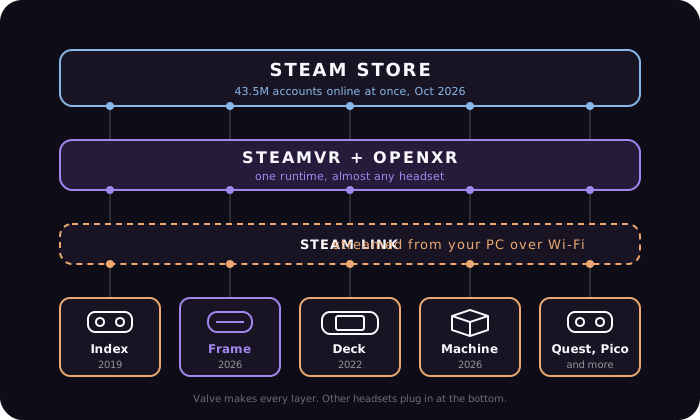
My bet: in a couple of years, "VR gaming" will mostly mean Steam on a headset, whoever made the headset. Your library comes with you, and that's hard to compete with.
Smart Glasses Are Coming, Whether We Like It or Not
Smart glasses are selling. Counterpoint says AI glasses shipments were up 263% in the first half of 2026, compared with a year earlier. Meta has 94% of that market.
Most of these glasses (96%) don't have a screen. They're a camera, microphones, speakers and an AI assistant in a normal-looking frame. Glasses with a display are a much smaller group, but they grew about 450%. Meta's Ray-Ban Display costs $799.
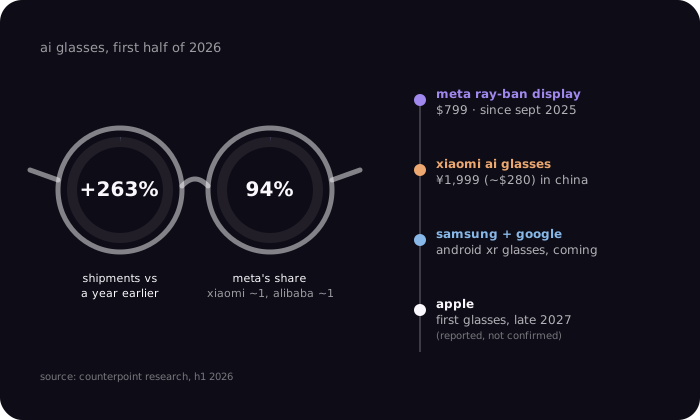
China is right behind. Xiaomi sells its AI Glasses for 1,999 yuan (about $280), Alibaba has its own, and Rokid leads the glasses-with-a-display segment. China is a bigger market for display glasses than the US. Samsung and Google are getting their first Android XR glasses ready. Apple is the slowest: Bloomberg's Mark Gurman reports its first glasses will be shown at WWDC in June 2027 and ship late in 2027, without a display.
The "whether we like it or not" part is privacy. In February, the New York Times reported that Meta was planning face recognition for its glasses. In April, EPIC and 63 other groups wrote a letter opposing it. In June, WIRED found face recognition code (switched off for now) in the Meta AI app, which has more than 50 million installs. Meta says it hasn't made a final decision.
People don't love the idea of a camera on a stranger's face. Shipments went up anyway. I think glasses will follow the phone: most people will be wearing them before the rules catch up. I'd rather we argue about those rules now.
The Robot Hype Is Overblown
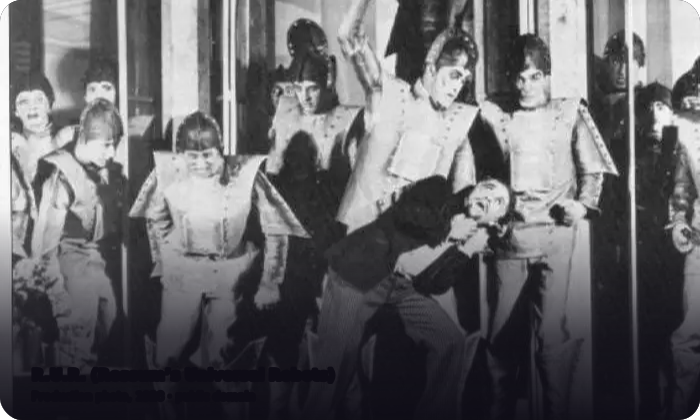
Karel Čapek's play R.U.R. gave us the word "robot" in 1920. More than a hundred years later, humanoid robots are mostly still demos.
Here's where prices sit. Unitree's G1 starts at $13,500. 1X's NEO home robot is $20,000, or $499 a month, and reports say it still leans on remote operators in VR headsets for a lot of household jobs. Tesla hasn't put a price on Optimus, and wide release has reportedly slipped to 2027. Figure has around 40 of its robots on a BMW line, reportedly billed at about $25 per robot per hour.
My rough rule: a robot costs ten times as much as software to build and keep running. It needs batteries, motors, spare parts, repairs and someone to keep an eye on it. Software needs a server. Look at what a month costs, and ten times is generous.
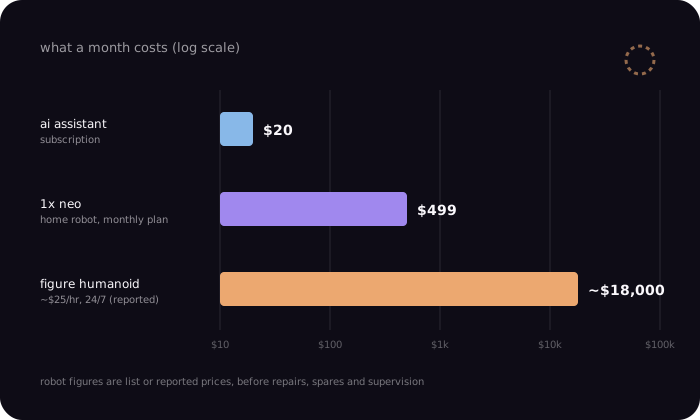
So robotics is riding on AI's coattails. As long as the AI bubble doesn't pop, the money keeps flowing to robots too. If it does pop, the robots go down with it.
Economic
The First Shockwaves
The early shockwaves of the AI boom are in, and there's more to come.
In early February, Anthropic released plugins for Claude Cowork, an AI agent that does office work like legal research, sales records and analytics. Software stocks dropped. By 5 February, the S&P 500 Software & Services index had fallen eight days in a row and was down about 20% for the year. The worry is simple. Most SaaS (software as a service) charges per seat, per person using it. If an agent does the work, you need fewer seats.
Not everyone bought it. Nvidia's Jensen Huang called the idea that AI will replace enterprise software "the most illogical thing in the world". He might be right about the big systems. I still think the small, single-purpose tools are in trouble, because you can now build your own in an afternoon.
Consulting and the professions are next. The Big Four firms have been cutting graduate hiring, and PwC's UK boss said in 2025 that AI was part of the reason. McKinsey is going the other way and says it'll hire 12% more in North America this year. But I think the trend is clear. Professionals who charged a premium for knowing how to do something are being undercut at every turn, because the knowing part is getting cheap.
The low-hanging fruit is being plucked right now, and it'll take a while to sink in. Most of our data gets collected and analysed after the fact, so we're usually a step behind. Automation is already here. I think we need to reckon with it sooner rather than later.
Is It Even a Bubble?
The hyperscalers and the rest of the AI companies run the stock market now. By JPMorgan's count of 41 AI-linked companies, AI made up 49% of the S&P 500's value in early October. In Bank of America's April survey, 54% of fund managers called AI stocks a bubble.
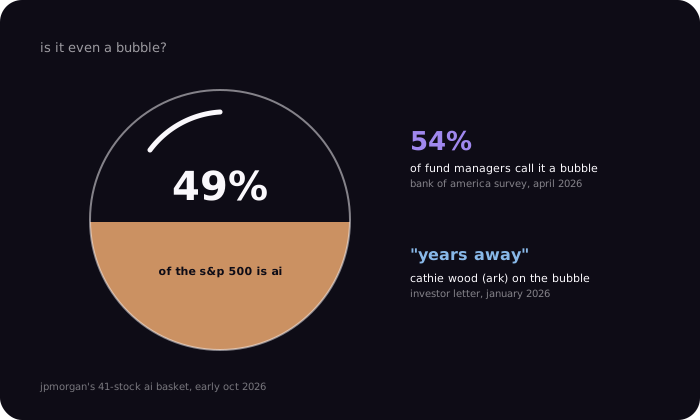
So is it a bubble? Or does singularity economics play by different rules? Cathie Wood of ARK would argue the latter. In January she wrote that a bubble is "years away", and that people are taking up AI twice as fast as they took up the internet in the 1990s. Most economists are heading for their bunkers. I don't know. If the singularity is here, the old yardsticks for "overvalued" might not apply.
The Energy Crunch

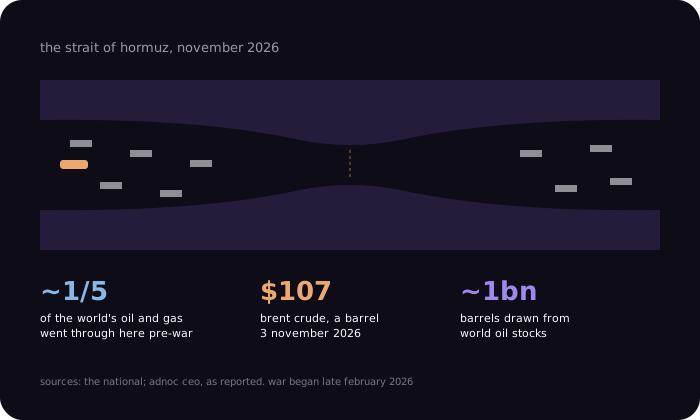
An energy crunch is squeezing the world. The US and Iran have been at war since late February, and the Strait of Hormuz has been mostly shut to commercial shipping. Before the war, about a fifth of the world's oil and gas went through it.
Brent crude was about $107 a barrel this morning, after US strikes on Iran's Qeshm Island overnight. ADNOC's chief executive says the disruption has helped drain about a billion barrels from the world's oil stocks. When oil can't move across the seas, everything that runs on it costs more to move, on ships and on highways.
Political
The 99% vs Each Other
This one is opinion.

Politicians and big tech will keep dividing us, on purpose. Anger keeps people scrolling, and it wins votes. Divisive politics pits the 99% against each other, and while we're busy fighting, we don't look up at the 1% who are taking as much as they can.
The monopolies are doing fine. In August 2024, a US judge ruled that Google had an illegal monopoly in search. A year later, the remedy let Google keep Chrome and Android. In November 2025, a different judge ruled that Meta wasn't a monopoly, so it keeps Instagram and WhatsApp.
People do disagree about plenty of things, for good reasons. I just think a lot of the fighting is being stoked by people who profit from it. Turning off notifications helps. I wrote about that too.
Pay to Play
In the US, the scandals keep coming. In May, Democrats in the House and Senate wrote to 17 people who'd received pardons or commutations from President Trump, asking about lobbyists and donations. One of them is Binance founder Changpeng Zhao, pardoned in October 2025 after Binance partnered with World Liberty Financial, a crypto company founded by the Trump and Witkoff families. In August, House Judiciary Democrats published a report calling it "Pardons, Inc."
That report is partisan, and nothing has been proven. The White House says it has a "robust pardon review process" and that anyone paying to lobby for a pardon is wasting their money. But the pattern is hard to ignore.
Tax Talk Is Coming Back
As inequality grows, I think we'll hear a lot more about tax. Today, Californians vote on Proposition 40, the Billionaire Tax Act. It's a one-time 5% tax on residents worth $1 billion or more, spread over five years. Economists Emmanuel Saez and Gabriel Zucman, who back it, estimate that California's billionaires paid an average of 0.26% of their wealth a year in state income tax between 2019 and 2025.
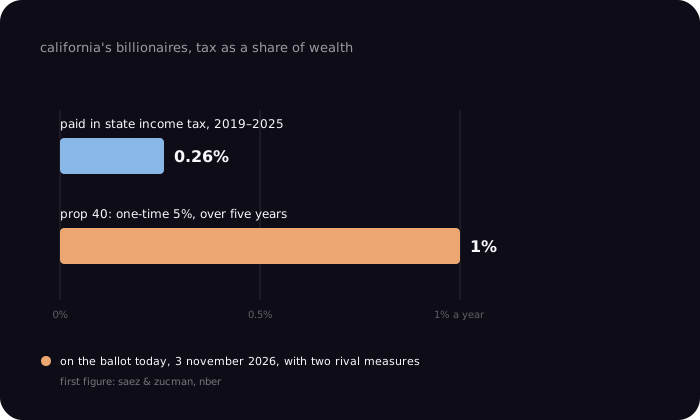
It's on the ballot next to two rival measures that would undercut it, and a group funded by Google co-founder Sergey Brin has reportedly put $82 million into fighting it. Whichever way it goes, I expect it won't be the last wealth tax on a ballot.
The World Isn't US-Centric

In 1602, Matteo Ricci and Li Zhizao printed a world map in Beijing with China near the middle. A lot of the world sees it that way again.
In July, Pew published a survey of 36 countries. In 25 of them, people now see China more favourably than the US. Only six still prefer the US: Israel, Japan, India, South Korea, the Philippines and Poland. In Canada, favourable views of the US fell from 57% in 2023 to 33% this year, and views of China rose from 14% to 44%.
China is leading on a lot of the technology, and the diplomacy, despite its own problems. It sold about six in ten of the world's electric cars in 2025, according to the IEA. It makes 80% to 95% of the world's solar panel parts, depending on which part of the chain you count. And as above, it's putting out the biggest open AI models.
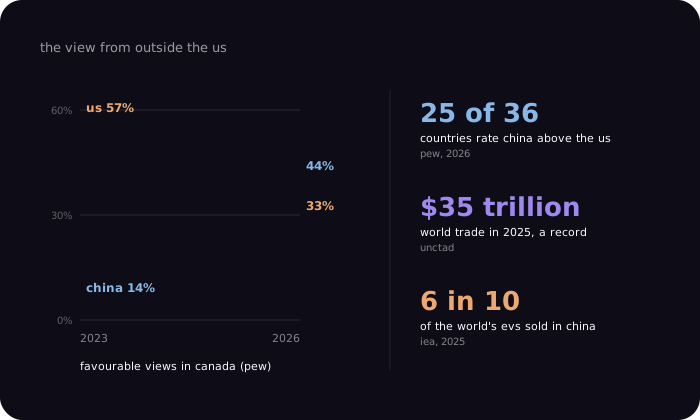
Globalisation never went anywhere. World trade passed $35 trillion for the first time in 2025, up about 7%, according to UNCTAD. China's trade surplus passed a trillion dollars, which makes plenty of countries uneasy. Europe kept building too. In January, the EU signed its trade deal with Mercosur (Argentina, Brazil, Paraguay and Uruguay) after more than 25 years of talks, and wrapped up talks on a deal with India covering about two billion people. The US got isolationist, and everyone else kept trading.
From South Africa, that's easy to see. We're in BRICS with Brazil, Russia, India and China, and China is our biggest trading partner.
So, Where Does That Leave Us?

If I had to boil it down: people are anxious and checking out, machines are doing more of the thinking, energy is expensive, and the US isn't the centre of everything anymore.
For a small studio like mine, there's still a lot of good news in there. The tools are cheap, the platforms are open enough to ship on, and the audience is the whole world.
I'll check back in a few months and see how wrong I was. ;)
More info:
- NEET time use (American Time Use Survey analysis): https://aibm.org/research/how-neets-spend-their-time/
- Retirement surveys: https://www.newsweek.com/americans-retirement-plans-take-hit-cost-living-bites-12533568 and https://www.aol.com/lifestyle/study-says-1-issue-people-183544519.html
- Horror box office, 2026: https://www.yahoo.com/entertainment/movies/articles/horror-boom-2026-bigger-halloween-140000768.html and https://screenrant.com/obsession-movie-highest-grossing-horror-2026-record/
- 2026 worldwide box office: https://www.the-numbers.com/box-office-records/worldwide/all-movies/cumulative/released-in-2026
- Spotify on country and emotional pop: https://www.aol.com/articles/spotify-predicts-country-emotional-pop-130000000.html
- Gen Z hip-hop and phonk (Chartmetric): https://hmc.chartmetric.com/is-hip-hop-really-dead-2026/
- OpenAI's unit distance disproof: https://www.scientificamerican.com/article/ai-just-solved-an-80-year-old-erdos-problem-and-mathematicians-are-amazed/ and https://openai.com/index/model-disproves-discrete-geometry-conjecture/
- Hugging Face open model report, summer 2026: https://www.tun.com/home/hugging-faces-2026-open-model-report-qwen-leads-hype-vs-reality/
- Steam, Frame and Valve sources: Steam Is Becoming VR's Gold Standard
- Smart glasses shipments (Counterpoint, H1 2026): https://9to5google.com/2026/09/22/smart-glasses-growth-h1-2026/
- China's smart glasses prices: https://startupfortune.com/chinas-smart-glasses-sales-double-as-xiaomi-and-rokid-undercut-meta-on-price/
- Apple glasses timing: https://roadtovr.com/apples-smart-glasses-unveil-wwdc-2027-release-date/
- Meta glasses and face recognition: https://www.computing.co.uk/news/2026/meta-explores-facial-recognition-smart-glasses
- Humanoid robot prices: https://theresarobotforthat.com/blog/humanoid-robot-companies-2026-complete-guide/
- Software stock sell-off, February 2026: https://www.cnbc.com/2026/02/06/ai-anthropic-tools-saas-software-stocks-selloff.html
- PwC and graduate hiring: https://fortune.com/2025/09/08/pwc-uk-chief-cutting-entry-level-junior-gen-z-jobs-ai-economic-headwinds-like-amazon-salesforce
- McKinsey hiring: https://www.storyboard18.com/amp/brand-marketing/mckinsey-counters-ai-job-fears-with-12-graduate-hiring-boost-in-2026-80845.htm
- AI share of the S&P 500: https://cryptobriefing.com/ai-stocks-49-percent-sp-500-concentration/ and https://www.kucoin.com/blog/ai-stocks-now-45-percent-of-sp500-is-a-us-stock-market-crash-coming-in-2026
- Cathie Wood on the bubble: https://www.thewealthadvisor.com/article/cathie-wood-sends-blunt-3-word-message-stock-outlook-2026
- Oil and Hormuz, 3 November 2026: https://www.thenationalnews.com/business/energy/2026/11/03/oil-prices-cross-105-after-us-strikes-on-irans-qeshm-island/
- Oil inventories (ADNOC): https://dinardetectives.com/hormuz-disruption-drives-1-billion-barrel-oil/
- Pardons probe: https://www.cbsnews.com/news/trump-pardon-recipients-democrats-congressional-investigation-pay-to-play/ and https://www.forbes.com/sites/alisondurkee/2026/05/07/democrats-investigate-whether-trumps-pardons-were-pay-to-play-here-are-the-big-time-donors-and-business-allies-hes-sprung-free/
- California Billionaire Tax Act: https://en.wikipedia.org/wiki/2026_California_billionaire_tax and https://www.nber.org/papers/w35218
- Pew, views of the US and China, July 2026: https://www.kunc.org/npr-news/2026-07-15/china-and-xi-favored-over-us-and-trump-in-many-nations-survey
- World trade, 2025: https://unctad.org/publication/global-trade-update-december-2025-global-trade-poised-record-breaking-2025-flows
- China's 2025 trade surplus: https://tradingeconomics.com/china/balance-of-trade/news/516803
- EU trade deals with Mercosur and India: https://www.sullcrom.com/insights/memo/2026/January/EU-Strikes-Major-Trade-Deals-Mercosur-India
- EV sales (IEA Global EV Outlook 2026): https://greentechlead.com/electric-vehicle/global-ev-sales-to-hit-23-mn-in-2026-as-china-dominates-electric-vehicle-boom-says-iea-53452
- Solar manufacturing (REN21): https://www.ren21.net/rbe/2026_China_Figure3
Images (all public domain, via Wikimedia Commons):
- The Sleep of Reason Produces Monsters, Francisco Goya, 1799: https://commons.wikimedia.org/wiki/File:Francisco_José_de_Goya_y_Lucientes_-_The_sleep_of_reason_produces_monsters_(No._43),_from_Los_Caprichos_-_Google_Art_Project.jpg
- Under the Wave off Kanagawa, Katsushika Hokusai, c. 1830–32, Metropolitan Museum of Art: https://commons.wikimedia.org/wiki/File:Tsunami_by_hokusai_19th_century.jpg
- R.U.R. production photo, 1928: https://commons.wikimedia.org/wiki/File:Capek_RUR.jpg
- The Fighting Temeraire, J. M. W. Turner, 1839, National Gallery: https://commons.wikimedia.org/wiki/File:The_Fighting_Temeraire,_JMW_Turner,_National_Gallery.jpg
- The Confusion of Tongues, Gustave Doré, c. 1865–68: https://commons.wikimedia.org/wiki/File:Confusion_of_Tongues.png
- Kunyu Wanguo Quantu, Matteo Ricci and Li Zhizao, 1602: https://commons.wikimedia.org/wiki/File:Kunyu_Wanguo_Quantu_by_Matteo_Ricci_All_panels.jpg
- The Blue Marble, Apollo 17 crew, NASA, 1972: https://commons.wikimedia.org/wiki/File:The_Earth_seen_from_Apollo_17.jpg