Steam Is Becoming VR's Gold Standard
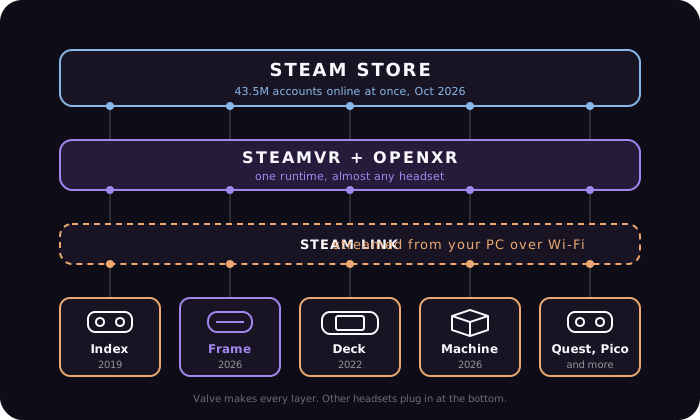
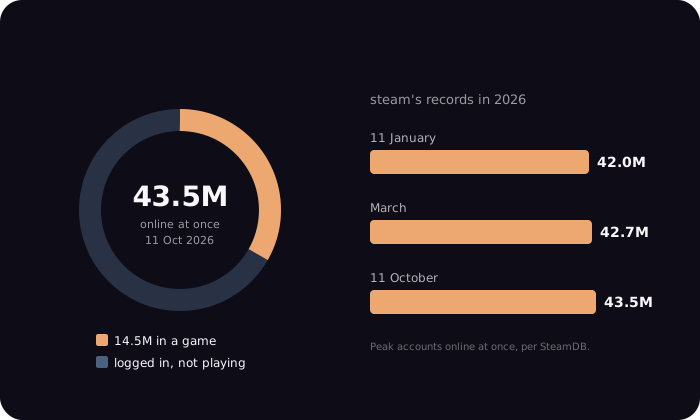
On 11 October 2026, Steam had 43.5 million people logged in at the same time. That's its third record this year. A month earlier, Valve shipped its first headset in seven years.
For as long as I've been making VR, people have argued about which headset will win. I've started asking something else: which platform do all those headsets end up plugged into? More and more, the answer is Steam.
Valve now has a piece at every layer. The store, the software that talks to your headset, the streaming, the hardware, the operating system and the flagship game. Here's how it all fits together.
Note: Prices are in US dollars, and everything here is as of 30 October 2026. The memory shortage this year pushed a lot of hardware prices up, Valve's included.
How We Got Here
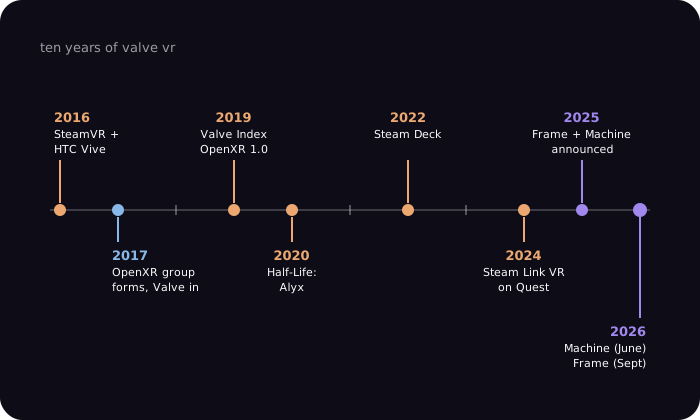
Valve has been at this for ten years. SteamVR launched with the HTC Vive in 2016, and Valve has put something new on the pile almost every year since.
SteamVR: The Bit in the Middle
SteamVR is the software between your games and your headset. A game talks to SteamVR, and SteamVR talks to whatever you're wearing: an Index, a Vive, a Quest, a Pimax, a Bigscreen Beyond or a Frame.
So on PC, the headset you buy doesn't lock you out of your games. Your library stays put and the hardware can change.
You can see it in the Steam Hardware Survey. In September 2026, the most common headset on Steam was Meta's Quest 3, at 26.9%. Valve's own Frame showed up at 0.41% in its first month. Meta sells most of the headsets, and plenty of their owners still come to Steam to play.
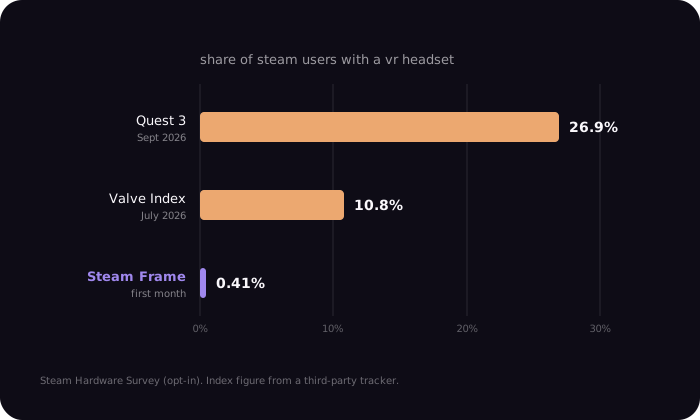
Take those numbers with a pinch of salt. The survey is opt-in, and UploadVR has pointed out some odd swings in its VR section this year. The Index figure comes from a third-party tracker. Still, the shape of it is clear enough: lots of people buy their headset from Meta and their games from Valve.
OpenXR: The Standard Valve Helped Write
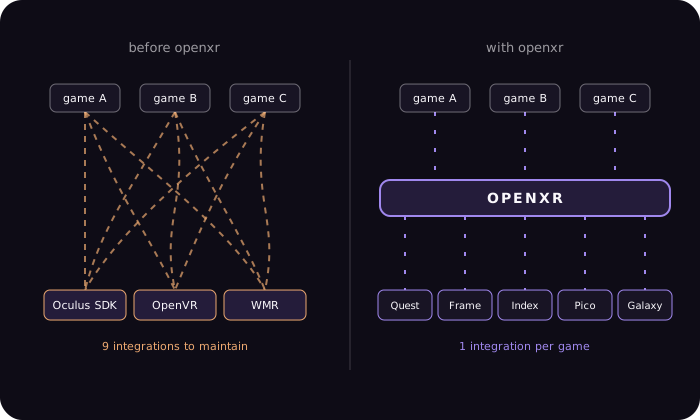
Before OpenXR, every headset maker had its own API (the code a game uses to talk to the hardware). Oculus had its SDK, Valve had OpenVR and Windows Mixed Reality had its own. If you wanted your game on all of them, you basically built it several times.
The Khronos Group (the people behind Vulkan and OpenGL) announced OpenXR in 2017, and Valve was in the working group from day one, alongside Oculus, Epic, Unity, Google and others. Version 1.0 came out in July 2019, and SteamVR had an OpenXR runtime by 2020.
Now one build can run on a Quest, a Frame, an Index, a Pico or a Samsung Galaxy XR. For anyone making VR, that's huge. It also means Valve doesn't need to own the headset to own the platform.
Steam Link: Cutting the Cable
Steam Link started in 2015 as a little box that streamed games from your PC to your TV. Valve stopped making the box in 2018 and turned it into an app. It runs on phones, tablets, smart TVs and even a Raspberry Pi.
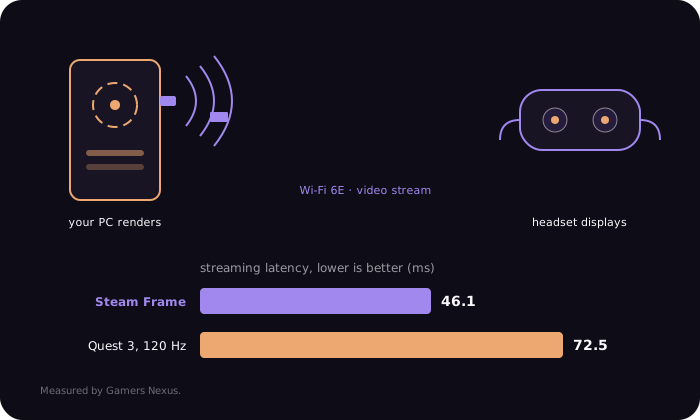
In November 2024 it came to Quest headsets as Steam Link VR, for free. Your PC does the heavy rendering, and the headset gets a video stream over Wi-Fi. Big graphics card in the study, light headset in the lounge. A lot of people play PC VR this way now.
The Frame builds a whole headset around that idea. It ships with a Wi-Fi 6E dongle that plugs into your PC, and it tracks your eyes so the stream sends the sharpest detail to wherever you're looking (this is called foveated streaming). Gamers Nexus measured 46.1 ms of streaming latency on the Frame, against 72.5 ms on a Quest 3 at 120 Hz. Latency is the delay between moving your head and the picture catching up, so lower is better.
Steam Deck: The Practice Run
The Deck isn't a VR device. But it's where Valve learned to make mobile hardware.
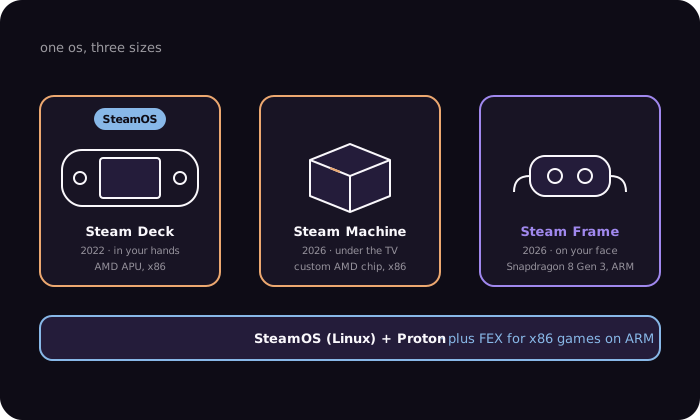
It came out in February 2022, with an OLED model in November 2023. It runs SteamOS, Valve's own Linux, and uses Proton to translate Windows games so they run without the developer porting anything. Valve's Deck Verified badges tell you how well each game runs before you buy it.
Almost every one of those lessons shows up in the Frame. It runs SteamOS. Proton (plus FEX, which translates x86 code for the Frame's ARM chip) lets it run flat Steam games on the headset itself. Battery and heat on a phone-sized chip are the same problem the Deck solved first. And there's a Frame Verified badge, where Valve asks for at least 72 fps at 1728×1728 during normal play.
Steam Machine: Valve's Own Box
The Steam Machine launched on 30 June 2026, sold through a reservation queue. It's $1,049 for 512 GB or $1,349 for 2 TB. It's a small gaming PC with a custom AMD chip, running SteamOS, and Valve says it's more than six times as powerful as the Deck. It was meant to ship early in the year, and the memory shortage pushed it back and pushed the price up.
So why count it as VR news? Because it's a PC Valve controls from top to bottom: the hardware, the OS and the drivers. Valve pitched it and the Frame as a pair. A Machine under the TV and a Frame on your face is the first time one company has sold you the whole PC VR setup, store included.
Index and the Knuckles
The Valve Index came out in June 2019 at $999 for the full kit. It had 1440×1600 screens per eye at up to 144 Hz, Lighthouse tracking (little base stations on your walls) and speakers that float just off your ears. For years it was the headset PC VR people measured everything else against. It still had around 10.8% of Steam's headsets this July, seven years after launch.
Valve confirmed this month that it has stopped making the Index, and the last ones are 20% off while stock lasts. If you already own one, nothing changes. It's still supported.
The controllers are the part I'd miss most. The Index Controllers (everyone still calls them Knuckles, their dev-kit name) strap to your hand, so you can open your fingers fully and let go of things without dropping anything. Each one has 87 sensors that read your hand's position, each finger, motion and how hard you're squeezing. In VRChat, they're why avatars can wave, point and give a thumbs up.
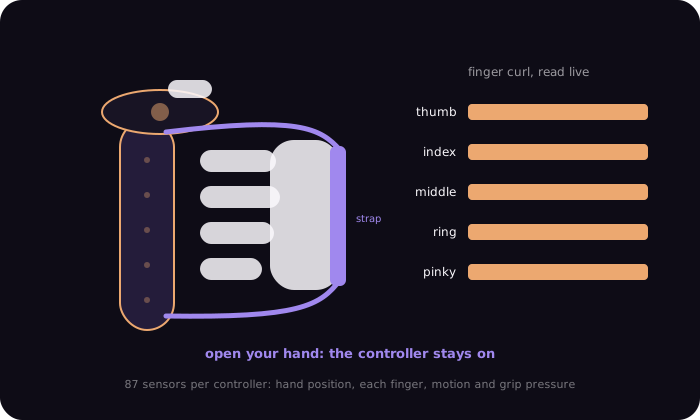
The Frame has its own controllers, with optional straps for a Knuckles-style fit.
Half-Life: Alyx
Half-Life: Alyx came out in March 2020 and scored 93 on Metacritic. It's still the game people point to when they talk about what a full-budget VR game can be. You pull things into your hand with the gravity gloves, almost everything around you can be picked up and thrown, and you hack locks by tracing circuits with the multitool.
Valve shipped Hammer, its level editor, for Alyx two months after launch, and the Workshop filled up with fan-made levels and campaigns. Six years on, Alyx comes free with every Frame.
The Store
Steam's record on 11 October was 43,505,724 accounts online at once, according to SteamDB. About 14.5 million of them were in a game at that moment, which was a record too.
VR's slice is small. Around 1.5% of survey respondents had a headset plugged in this August. But 1.5% of Steam is still a huge crowd, and they all shop in the same store as everyone else.
The flat library is coming along too, thanks to modders. Praydog's UEVR injects VR into almost any Unreal Engine 4 or 5 game, with head tracking and motion controls. Luke Ross's R.E.A.L. mods do the same for big titles like Red Dead Redemption 2. Mad props to both. And if a game hasn't been modded, the Frame will play it on a giant virtual screen.
Valve Is Fine With AI
In January 2024, Valve started letting developers publish games made with generative AI, as long as they say so on the store page. In January 2026 it narrowed the rules: you only need to disclose AI content that players actually see or hear. Tools you use behind the scenes, like a coding assistant, are exempt.
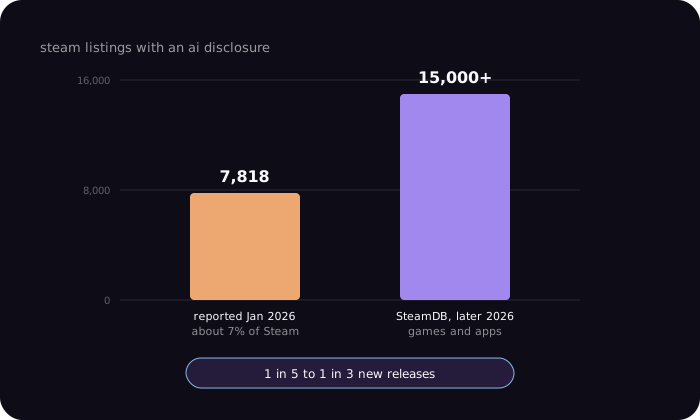
The labels are piling up. A count reported in January 2026 found 7,818 games with the disclosure, about 7% of Steam. A SteamDB search later this year turned up more than 15,000 games and apps with the label, and trackers put it at somewhere between one in five and one in three new releases.
AI is a very controversial topic. I use AI tools in my own work, and I like that Valve's answer is a clear label. Players can see it and decide for themselves, and developers and artists who use these tools have somewhere to ship. Disclosure is voluntary, though, so the true numbers are probably higher.
So, Gold Standard?
Not everywhere yet. Meta still sells far more headsets. The Frame is at 0.41% of Steam's VR users, its passthrough is black and white, and reviewers found plenty of older SteamVR games misbehaving on it at launch. Road to VR summed it up for the average gamer as a more expensive Quest 3. And with the Index gone, Valve's only headset costs over a thousand dollars.
But look at what Valve has: the biggest PC game store, the runtime almost every PC headset uses, and a cross-platform standard it helped write from the start. Its streaming works on headsets it doesn't even make, its own OS runs on a handheld, a small PC and a headset, and Alyx is still the VR game everyone else gets compared to. Add a clear position on AI, and it's an easy place for small teams to ship.
Nobody else has all of those at once. If you're making VR in 2026, Steam is the one platform you can't skip. I think that makes it the gold standard, even if it doesn't sell the most headsets.
If you're shopping for a headset, here's my top five for 2026. Then come find me in VRChat. ;)
More info:
- Steam concurrent record, October 2026: https://dotesports.com/general/news/steam-all-time-record-43-5-million-concurrent-users
- Steam Machine price and date: https://pcworld.com/article/3172143/the-steam-machine-finally-has-a-price-and-date-1049-june-25th.html
- Steam Frame review: https://roadtovr.com/valve-steam-frame-review/
- Steam Frame review roundup (latency figures): https://space4games.com/en/virtual-reality-en/steam-frame-reviews/
- Steam Hardware Survey, September 2026: https://www.digitalcitizen.life/meta-quest-3-retakes-top-spot-steam-hardware-survey-september-2026/
- Steam Frame's first survey reading: https://vr.org/articles/steam-frame-first-steam-survey-reading-0-41-percent-september-2026
- Survey reliability: https://www.uploadvr.com/steam-hardware-survey-unreliable/
- Index discontinued: https://www.gamingonlinux.com/2026/10/valve-index-gets-sunset-with-a-discount-on-remaining-stock/
- Valve Index: https://en.wikipedia.org/wiki/Valve_Index
- Steam AI disclosure rewrite, January 2026: https://videogameschronicle.com/news/valve-has-significantly-rewritten-steams-rules-for-how-developers-much-disclose-ai-use
- AI disclosure counts: https://gigazine.net/gsc_news/en/20260120-steam-updates-ai-disclosure-guidelines
- OpenXR: https://www.khronos.org/openxr/
- UEVR: https://uevr.io/