An Optimist's Guide to the Singularity
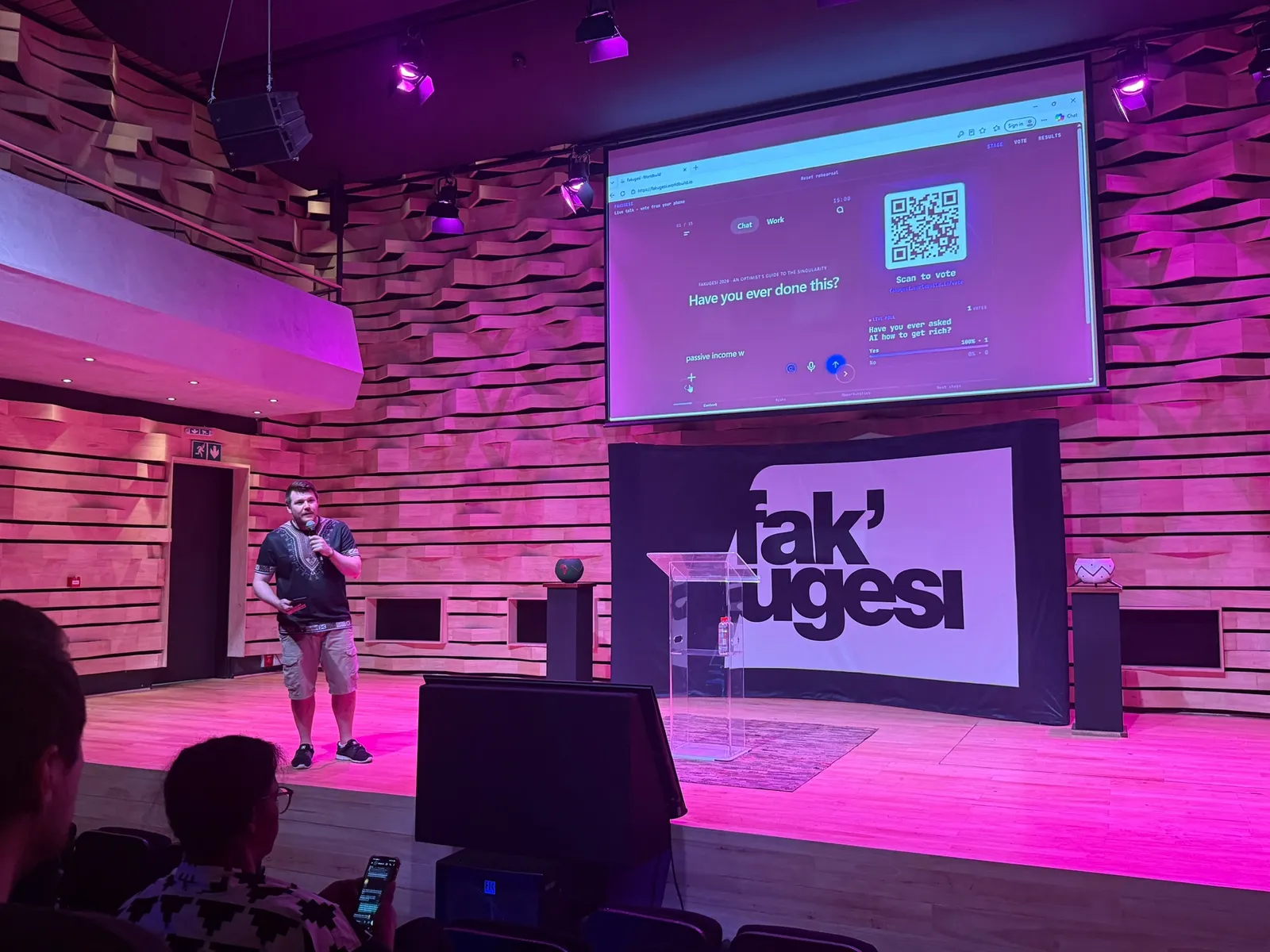
Have you ever asked AI how to get rich?
Five people in the room said yes. Seven said no. I believe about half of them. ;)
That was the opening question of my talk at Fak'ugesi on 15 October. The first slide looked like an AI chat app. Someone types "how do I get rich", deletes it, tries again. Nine times. On the tenth go they hit send, and the answer starts with two words: "Don't panic."
This is the talk written up, in the same four parts as the slides: context, risks, opportunities and next steps. (Glass Angels, our VR piece, was out on the exhibition floor too. That's over here.)
In a nutshell: machines are getting better at most of the work we thought made us valuable. That might make us less useful. It can't make our lives less worth living. Our value was never just our intelligence.
The deck is a website
I didn't use PowerPoint. The slides were a web app at fakugesi.worldbuild.io. Scan the QR code, a ballot pops up on your phone, and the results update on the big screen as people vote. All the charts and animations are just code. (I also had a PDF on standby in case the Wi-Fi died. Never trust venue Wi-Fi.)
1. Context
How I got here
In 2016 a documentary introduced me to Ray Kurzweil and his idea of the singularity. It stuck. A few years later I did an MPhil in Futures Studies and spent a lot of it staring at Moore's law. That turned into a paper, Precipicism, which I finally published in four parts in 2025. The claim hasn't moved. We're standing at a precipice, and things can still break better or worse from here.
The idea is older than Kurzweil. John von Neumann talked about an "essential singularity" in human affairs (Stanislaw Ulam passed that on in 1958). I. J. Good described an "intelligence explosion" in 1965. Vernor Vinge made the word famous in 1993. Kurzweil gave it a date and a bestseller in 2005.
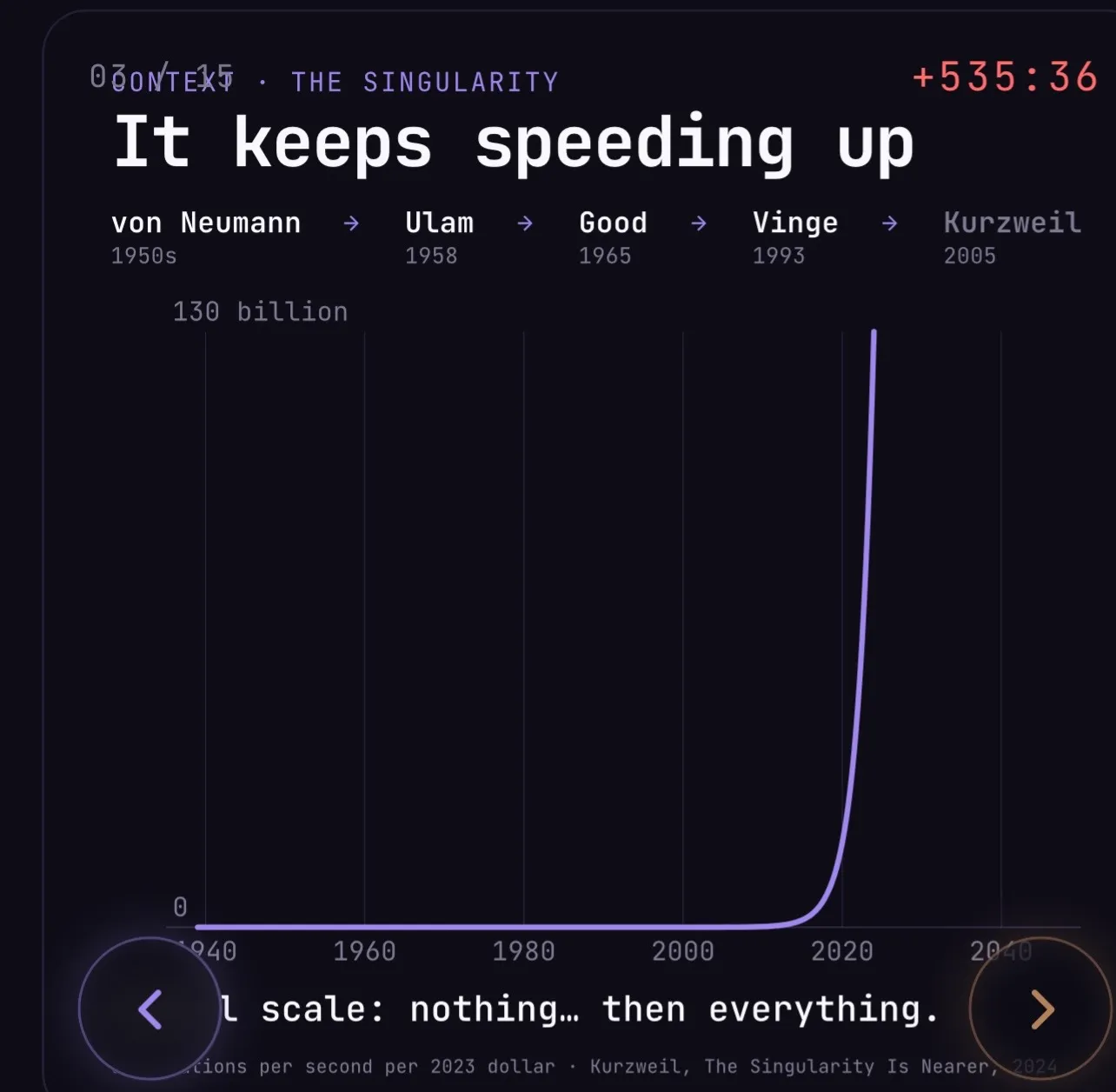
Kurzweil's chart of computing power per dollar is the bit that got me. On a normal scale the line is basically flat for decades, then it goes straight up. Wild.
Why I build in VR
So in 2018 I started a VR and AR business. My logic was pretty simple. If machines get good at everything, what's left? The answer I landed on: experience. Nobody can have your experiences for you. They have to be felt.
VR and AR were my answer to AI. Human experience can't be automated, and these are the tools that work with it directly. That's also why I started WeAReVR, which is now more than 250 creators in Jozi.
Things are changing. And people are worried.
2. Risks
Automation isn't new
The power loom, 1785. The assembly line, 1913. The first industrial robot on a factory floor, 1961. The spreadsheet, 1979. ChatGPT, 2022.
Automation has been taking jobs for more than two hundred years. There were about 4.7 million industrial robots working in factories by the end of 2024 (IFR, World Robotics 2025). The IMF reckons around 40% of jobs worldwide are exposed to AI, closer to 60% in advanced economies (Cazzaniga et al., 2024).
Jobs are at risk. No doubt about it. And it isn't just "menial labour" anymore. Machines are taking thinking work too. Mine included.
The real risk is people
The Bulletin of the Atomic Scientists set the Doomsday Clock to 85 seconds to midnight in January 2026. The closest it's ever been. Their list: nuclear weapons, climate, biosecurity, and AI and disruptive tech.
Notice that every one of those is a people problem. The algorithm doesn't want anything. People do. Autonomous weapons, engineered pathogens, propaganda: somebody builds those, and somebody pays for them. For now, at least, the danger is us.
Fear is the mind-killer
The one that worries me most is misinformation. False news spreads about six times faster than the truth (Vosoughi, Roy & Aral, Science, 2018).
Here's why that matters more than the rest. Every big problem we have (climate, inequality, the jobs thing) needs people to work together. To work together, we need to agree on what's real. Can we tell what's true? Do we trust the people making decisions? Can our institutions actually deliver? Are the costs and the benefits shared? Break the first one and the rest go with it.
And fear sells. Your worry is rational. Selling it back to you is the problem.
During this part of the talk, someone voted worried. Fair enough. That was kind of the point: watch how quickly fear moves a room.
But that isn't the whole story.
3. Opportunities
A door closed, a window opened
Honestly? AI wiped out a good chunk of my competitive edge. Things I spent years learning, a model now does in seconds. Sometimes better.
It also made it way cheaper to make stuff. I've promoted myself to head of quality assurance and outsourced most of my programming to bots. I'm working in languages I couldn't touch two years ago. I've never been more empowered as a maker. Both of those things are true at once.
Making stopped being scarce. Meaning didn't. We've been here before: photography freed painting from having to look real, and we got Impressionism. Cheap software and bedroom producers gave us amapiano.
It isn't just me
Hans Rosling spent his career showing people that the world was getting healthier and wealthier while everyone assumed the opposite. His bubble charts (from Gapminder) are still the best antidote to doom I know.
And the tools are already doing real good. AlphaFold predicted the shapes of proteins well enough to win a Nobel Prize in Chemistry in 2024. A six-week AI tutoring programme in Edo State, Nigeria, gave students gains that the World Bank estimates at one and a half to two years of normal schooling (From Chalkboards to Chatbots, 2025).
Not naïve optimism, though. Intelligence isn't wisdom. A smarter tool in the wrong hands is still the wrong hands.
Our value was never our intelligence
So what if machines get better than us at everything?
About 73,000 years ago, someone at Blombos Cave, down near Still Bay, drew a cross-hatched pattern in ochre on a flake of stone (Henshilwood et al., Nature, 2018). It's the oldest known drawing. Nobody drew that to get paid.
Art, storytelling, 3D, myth, entertainment, culture, philosophy. That isn't what's left over when the machines take the work. It's what we're for.
The singularity may change what it means to be useful. It doesn't have to diminish what it means to be human.
Experience can't be automated
This is the bit I've lived for eight years. WeAReVR started as a room of people trying a headset for the first time. During lockdown we met inside VR. Now it's packed rooms, hands-on demos, and a crowd of artists, coders and storytellers making things together.
I've started calling what I do cybernetic psychonautics. It's a mouthful. In plain words: using tech to explore how we see ourselves and each other. You shape an experience, it changes your perspective, and you come back to it changed. Automation threatens identities built on being competent. Art can show people another place to stand: caring, inventing, making mistakes, building things together.
The risks and the opportunities are both real. So what do we actually do?
4. Next steps
Let's be realistic
Epictetus, about 1,900 years ago:
We must make the best use that we can of the things which are in our power, and use the rest according to their nature.
(It's the idea behind the Serenity Prayer.)
None of us steers AI alone. As I write this, Anthropic has the lead. No wait, Google. Hang on, OpenAI. Now Alibaba? You know what, never mind. Agency isn't control. We still choose what we build, who we build it with, and what we demand from the people who own the infrastructure.
And let's be honest: meaning doesn't pay rent. That's exactly why the "together" part matters. Stokvels, and taxi fares passed forward hand to hand, are proof that we already know how to cooperate when nobody's in charge.
What do you love?
The last poll asked one question, with four answers: art, storytelling and culture; exploration, tech and innovation; building, deals and organising; justice, dignity and cooperation.
Most of the room picked art. Nobody picked justice, dignity and cooperation. That's the gap. If that's you, we need you.
Sitting in that room was someone who knew something the person next to them didn't. A skill that fits yours. The missing piece of the project you'd rather be doing than paperwork. That's true of every room, including the one you're in now.
The AI renaissance
The AI renaissance is here, and it won't come without its challenges. It's also a moment to work out who we are and what we value, on our own and together.
So, what are we going to build with these superhuman abilities? Let's make things together. Tell stories. Learn together. Grow the pie. Pessimism treats the pie as fixed. Optimism grows it.
Want to find collaborators? Join WeAReVR. Want to work with me? Get in touch.
Don't panic. Let's build.
Related: Glass Angels at Fak'ugesi 2026, Spatial computing notes.