An Open Letter to Festival Directors and Curators: Make Entry Simple
Dear Festival Directors and Curators,
First, thank you. Festivals have given my work some of its best homes, and I've met so many of my favourite people in your programmes, your venues and your worlds. What you do matters a lot to people like me.
So I say this as a fan: I've passed up a lot of your calls for entry lately.
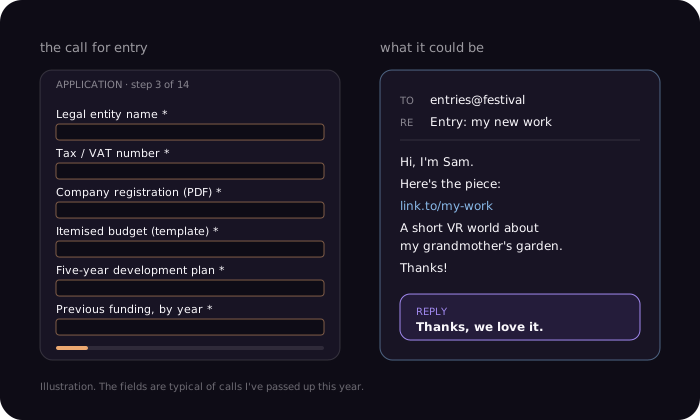
Not because the festivals were bad, or because I didn't have work to show. I passed because the forms were too much. Fourteen steps. A tax number. A company registration certificate. A budget in your template. A five-year development plan. Signed declarations, uploaded as PDFs only. By step three, I close the tab.
I don't think I'm the only one. So here's my ask: make it easy. Make it simple.
Every Hoop Costs You Artists
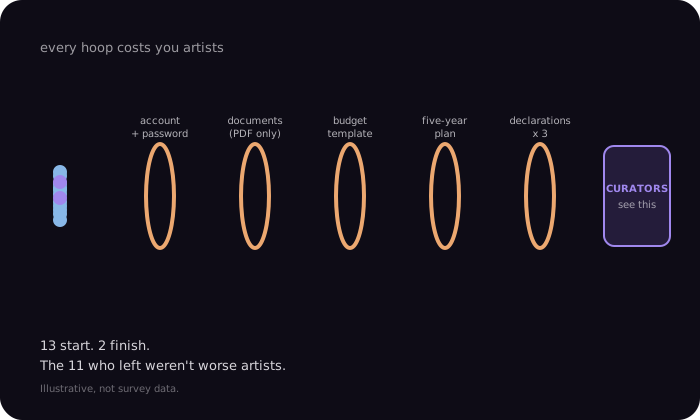
Every mandatory field is a hoop. Some people jump through it, and some don't. The more hoops you add, the more people drop off before they ever hit submit.
And the ones who drop off aren't worse artists. They're busier, or newer, or working alone, or just put off by paperwork that has nothing to do with the work. You never get to see what they would have sent you.
Who Actually Has Time for This?
Big established studios and big names can hire someone to work through endless forms and mandatory fields. That's fine. Good for them.
But what about the rising tide of small independent artists and creators? For a solo artist, every hour on an application is an hour not spent making the thing they're applying with. Two weeks before a deadline, that's a real cost.
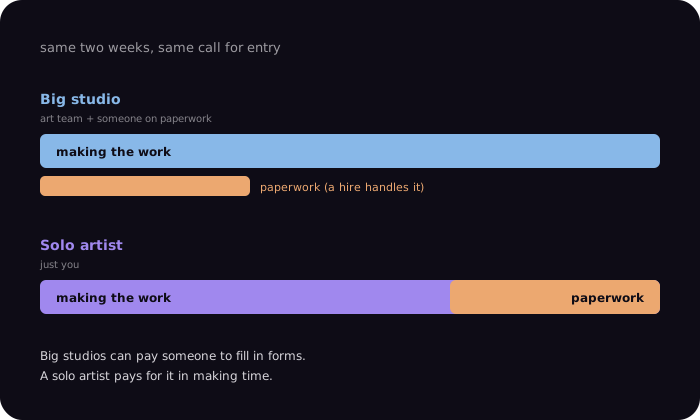
So the forms end up filtering for one thing: who has the time and staff to fill in forms. I don't think any of you set out to favour the big names over the independents. But that's what a long form does.
I Get Why It Happens
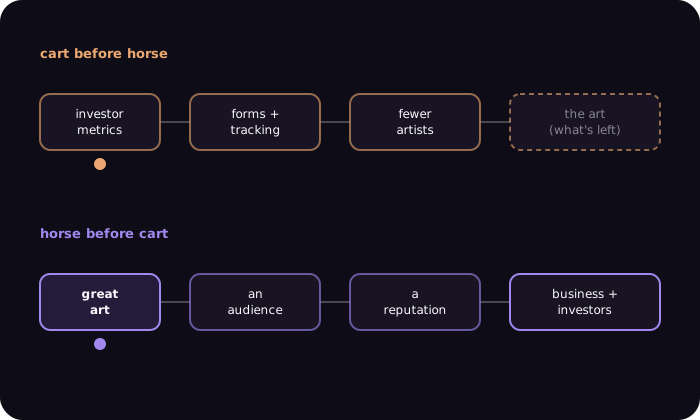
You're trying to build a festival that lasts, with a business model that scales. Investors and funders often want granular details. Who built what. How many people are on the team. How the studio has grown since last year. So the application slowly turns into a data-collection tool.
Some calls go further and track artists and studios over time, checking in on their progress year after year. Honestly, that feels overreaching and a bit off-putting. I'm applying to show a piece of work, not signing up to be monitored.
It also puts the cart before the horse. People come to your festival for the artwork. Great work brings an audience. An audience builds a reputation. And a reputation is what brings the business and the investors. Start with the data, and it's easy to lose sight of what makes festivals enjoyable in the first place: really good art.
If you need the paperwork for funders, ask for it after you've picked the work. Ask the twenty artists you selected, not the two thousand who might have applied. We'll happily fill in the forms once we're in.
What I'd Love to See
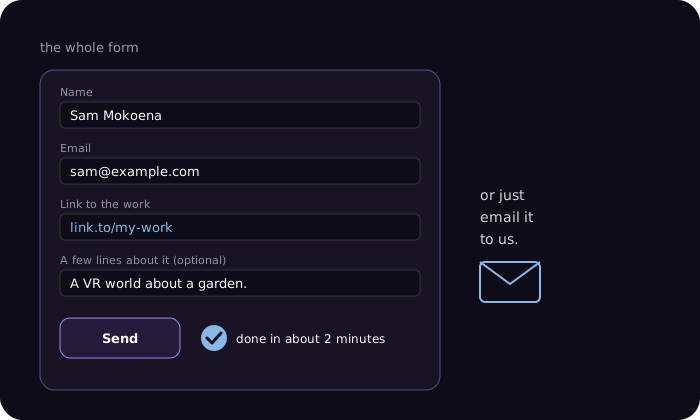
Here's the whole form:
- Name
- Link to the work: a video, a build, a world, a portfolio page
- A few lines about it: optional
That's it. Two minutes. And if someone emails you instead, please accept it. An email with a link and two lines about the piece tells you almost everything you need to know at this stage.
Replying matters too. Even a short "thanks, we got it" or "not this year, but keep us posted" goes a long way. Silence after a fourteen-step form is how you lose someone for good.
You're the Curators. Curate.
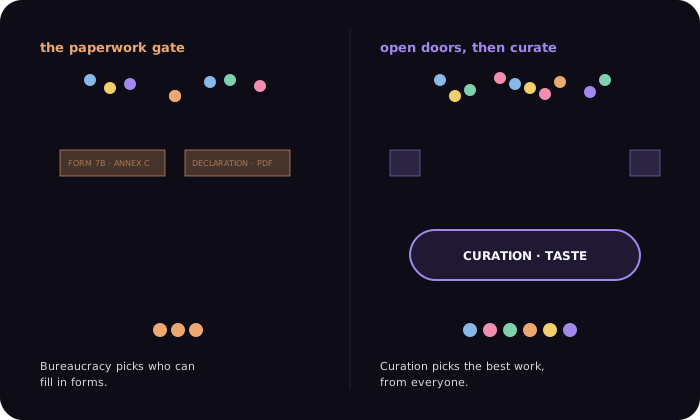
What should decide what gets into your festival is curation. Your taste. In 2026, with more work being made than ever, I think good taste is one of the most valuable skills there is, and it's exactly the thing you're best at.
Bureaucracy shouldn't be the judge of entry. A form can't tell you whether a piece is moving, or strange, or new. It can only tell you who had the time to finish the form.
So, my wish list:
- Keep the form short. Name, email, link, a few lines.
- Accept emailed entries, and reply to them.
- Ask for paperwork later, and only from the artists you select.
- Drop the long-term tracking. Let artists show their work without signing up to be monitored.
- Trust your taste. That's what we're all coming to you for.
We can keep the narrow gate and keep seeing the same names. Or we can fling open the doors, curate from a much wider selection of work, and celebrate the diversity and creativity that's out there.
It's up to us. I'd love to see your next call in my inbox.
Thanks for reading,
Deac