360 Video in VR: From Cardboard to World Models
360 video is the oldest trick in VR. You put a camera with lenses facing every way in the middle of a room, press record, and later someone puts on a headset and stands where the camera stood.
It sounds simple, and it is. It's also given us some of the most moving work the medium has ever made. In 2021 I built VRChat preview worlds for two of them, Reeducated and The ISS Experience, for the Venice film festival.
So here's the long version. What 360 video actually is, why it often looks softer than you'd expect, where it came from, the pieces worth your time, how to show it in VRChat, and what happens to it now that AI can make up a whole world from a sentence.
Note: Everything here is as of 5 November 2026. The players embedded below are 360 videos: click and drag inside them to look around, or open them on a headset for the real thing. Sources are at the bottom.
TL;DR
- What it is: a video you stand inside. You can look anywhere, but you can't walk around (that's called 3DoF, three degrees of freedom).
- Why it looks soft: an 8K 360 video spreads its pixels around the whole circle, so the slice you're looking at is about 1080p.
- What to watch: Clouds Over Sidra, The Displaced, Pearl, Reeducated and Space Explorers: The ISS Experience, to start.
- VRChat: paste a link into a player, wrap the video round a sphere or the sky, and everyone watches together. Self-host the file if you want it sharp.
- AI: generated 360 is cheap and getting better, and world models let you walk around inside it. That makes footage of a real place, captured by someone who was there, worth more.
What 360 Video Actually Is
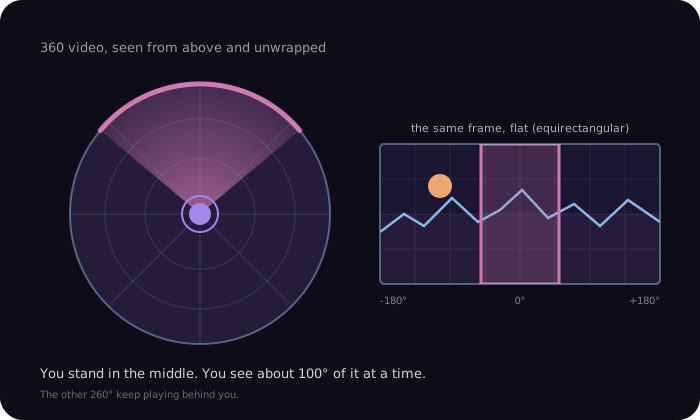
A 360 camera has two or more wide lenses pointing in different directions. Software stitches their pictures into one frame that covers every direction at once: up, down, behind you, all of it.
That frame is usually stored flat, as a rectangle twice as wide as it is tall. This is called equirectangular, and it's the same trick a world map uses to flatten the globe. In a headset, the player wraps it back round the inside of a sphere and puts you in the middle.
You can turn your head and look anywhere. You can't lean in or walk across the room, because the camera only ever stood in one spot. That's the big difference between 360 video and a game-engine world, where you can move. VR people call it 3DoF (you can rotate in three ways) versus 6DoF (you can rotate and move).
It's a real limit. It's also why 360 feels so honest when it works. You're seeing exactly what was there, from exactly where someone stood.
Mono, Stereo and 180
Not all 360 is packed the same way.
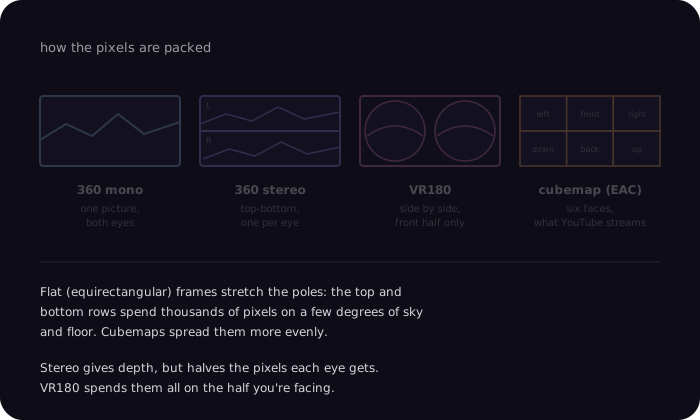
- 360 mono: one picture for both eyes. The world looks flat, like it's painted on a big ball around you. Most consumer 360 cameras shoot this.
- 360 stereo: a separate picture for each eye, usually stacked top and bottom. Things have depth, but each eye gets half the pixels, and stereo 360 is hard to shoot without visible seams.
- VR180: stereo, but only the half in front of you. You lose what's behind you, and you gain sharpness and much easier stitching. A lot of the best-looking immersive video now is 180, including Apple's Immersive Video format.
- Cubemap (EAC): the sphere cut into six square faces. Google introduced the equi-angular cubemap in 2017 because flat equirectangular frames waste a lot of pixels stretching the top and bottom. YouTube converts 360 uploads to it behind the scenes.
Why 8K Looks Soft
This is the bit that surprises everyone. You buy an 8K 360 camera, put the footage in a headset, and it looks... fine. Not 8K fine.
Here's why. An 8K 360 frame is 7,680 pixels wide, but those pixels have to cover the whole circle. Divide 7,680 by 360 degrees and you get about 21 pixels for every degree you look across. You only see about 100 degrees at a time, so the slice in front of you is roughly 2,100 pixels wide. That's about a 1080p picture, stretched across your whole field of view.
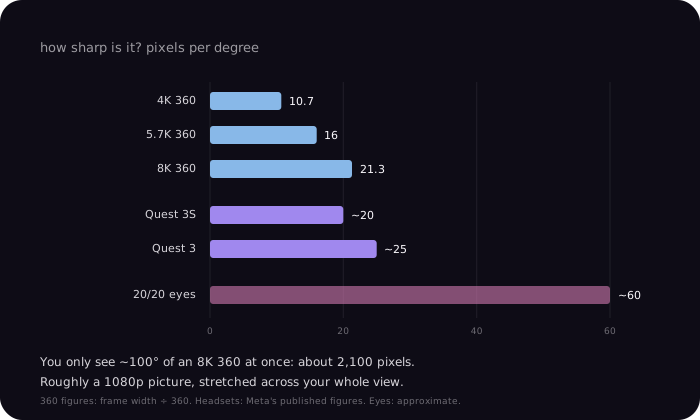
Meta rates the Quest 3's display at 25 pixels per degree. So 8K 360 mono is just under what a Quest 3 can show, and 4K 360 is less than half. 20/20 vision is somewhere around 60. For stereo 360 at the same sharpness, you'd need about 16K. That's why serious immersive work has moved towards 180, which puts all its pixels in front of you.
Bitrate matters just as much. UploadVR found in 2024 that plenty of "8K" 360 videos on YouTube were capped at 4K in the Quest 3's quality menu, with visibly lower bitrate than Apple's immersive films. On the decoding side, the Quest 3 tops out around 8192×4096 at 60 frames a second, by third-party tests (Meta doesn't publish a figure).
Sound
Half of presence is sound. 360 video can carry spatial audio, usually first-order ambisonics: four channels that describe sound coming from every direction, so a voice behind you stays behind you when you turn your head. YouTube supports it, and so do most headset players.
Some productions add a "head-locked" stereo track on top, for music or narration that stays put however you turn. YouTube's own docs still describe that option, and at least one guide says it's been dropped, so test it before you rely on it.
A Short History
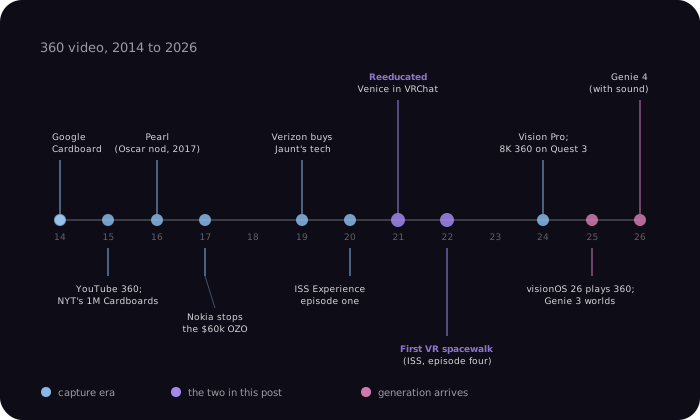
360 photos and panoramas go back a long way, but 360 video in a headset really starts in 2014.
That June, Google handed out about 6,000 folded cardboard viewers at its developer conference. Put your phone in one and you had a VR headset for a few dollars. A year later, everything happened at once. Clouds Over Sidra premiered at Davos in January 2015. YouTube started accepting 360 uploads in March, and Facebook added 360 video to the News Feed in September. In November, The New York Times launched its VR app and posted more than a million Google Cardboards to its subscribers with the weekend paper, along with its first film, The Displaced.
Then came the money, and then it went. Nokia launched its OZO camera at $60,000 in 2015, and stopped making it in October 2017. Jaunt raised about $100 million to make cinematic VR, pivoted to AR, and sold its technology to Verizon in 2019. A lot of people decided 360 was a fad.
The artists didn't. Pearl got an Oscar nomination in 2017. Felix & Paul Studios kept winning Emmys. Journalists kept using it to take people places they'd never otherwise go. And the cameras got cheap and good, so anyone could try.
Now it's having a second life, with sharper headsets, Apple's Immersive Video, VR180 and a new question hanging over it: what happens when the world in the sphere can be generated?
Pieces Worth Your Time
Here are some of the best 360 films that are free to watch. Every one of these players is a real 360 video, so drag inside it to look around. On a headset, open the same video in the YouTube app and it'll surround you.
Clouds Over Sidra (2015)
Gabo Arora and Chris Milk made this with the United Nations. It follows Sidra, a 12-year-old girl living in the Za'atari refugee camp in Jordan, through an ordinary day. It premiered at Davos and is often described as the first VR film made for the UN. It's eight minutes long and it's still one of the best arguments for the medium.
Pearl (2016)
Patrick Osborne's short for Google Spotlight Stories follows a father and daughter through the years, all from the passenger seat of the same old car. The car is the stage, and you sit in it. Pearl was the first VR film nominated for an Academy Award (Best Animated Short, 2017), and it won an Emmy the same year.
HELP (2015)
Justin Lin, of the Fast & Furious films, directed this live-action creature chase with The Mill for Google Spotlight Stories. It's a good one for seeing how a 360 director keeps your attention when there's no frame: sound and movement pull you round to where the action is.
The People's House (2017)
Felix & Paul Studios walked a 360 camera through the White House with Barack and Michelle Obama as guides. It won the 2017 Emmy for Outstanding Original Interactive Program. Watch how still the camera stays, and how much the rooms do the work.
The Protectors: Walk in the Ranger's Shoes (2017)
Kathryn Bigelow and Imraan Ismail made this for National Geographic, following the rangers who protect elephants from poachers. It's in stereo 360 with spatial audio.
The New York Times' The Displaced (2015) belongs on this list too. It follows three children forced from their homes by war, and it won the Entertainment Grand Prix at Cannes Lions in 2016.
Reeducated
Reeducated is one of the most important pieces of 360 journalism made so far.
It was directed by Sam Wolson for The New Yorker, with reporter Ben Mauk and artist Matt Huynh. It rebuilds a "reeducation" camp in Tacheng, in China's Xinjiang region, from the memories of three men who were held there together. They were interviewed in Kazakhstan in December 2019.
There was no footage to film. Nobody gets a camera into those camps. So Huynh drew the camp in pen and brush, from the men's descriptions, and the studio Dirt Empire turned the drawings into a stereoscopic, hand-painted 3D space. Jon Bernson did the spatial audio. You stand inside the camp while the men tell you what happened to them there.
It's 20 minutes long and it's hard to watch. It premiered at SXSW in March 2021, where it won a Special Jury Recognition. It was in the Venice VR Expanded lineup that September. In 2022 it won a News & Documentary Emmy for Outstanding Interactive Media, and a Peabody.
The form matters here. Watched flat, it's a strong documentary. In a headset, the drawn walls are around you and close, and you understand the size of the room in your body. The men aren't asking you to imagine it. They're putting you there.
For Venice VR Expanded 2021, I built a VRChat preview world for Reeducated, so VRChat visitors could get a feel for it before watching the full piece on a headset. The film, and all the credit for it, belongs to Wolson, Mauk, Huynh, Dirt Empire and The New Yorker.
Space Explorers: The ISS Experience
At the other end of the scale, there's space.
Space Explorers: The ISS Experience is a four-part series by Félix Lajeunesse and Paul Raphaël of Felix & Paul Studios, made with TIME Studios. It was shot aboard the International Space Station over two years, on custom 3D 360 camera rigs based on the Z CAM V1 Pro. The episodes came out between October 2020 and July 2022.
You float in the station with the crew while they work, eat, sleep and look out of the window at Earth. In zero gravity there's no up or down, and 360 suits that perfectly.
The last episode, EXPAND, has the big moment: the first spacewalk filmed in cinematic VR. Felix & Paul built a "Space Camera" with nine 4K sensors, giving 8K 3D 360. Nanoracks hardened it for space, and the station's robotic arm, Canadarm2, carried it around outside while astronauts Akihiko Hoshide (JAXA) and Thomas Pesquet (ESA) worked on the station's solar arrays in September 2021.
The series won the 2021 Primetime Emmy for Outstanding Interactive Program. It's on Meta Quest, and the spacewalk is the centrepiece of THE INFINITE, a touring exhibition by PHI Studio and Felix & Paul that opened in Montreal in 2021.
The first two episodes were also in Venice VR Expanded 2021, and I built a VRChat preview world for them too. All the credit for the series goes to Felix & Paul Studios and TIME Studios.
Making It
Keep the Camera Still
The first rule of 360 is about your audience's stomach. When the picture moves and your body doesn't, your inner ear and your eyes disagree, and some people feel sick fast.
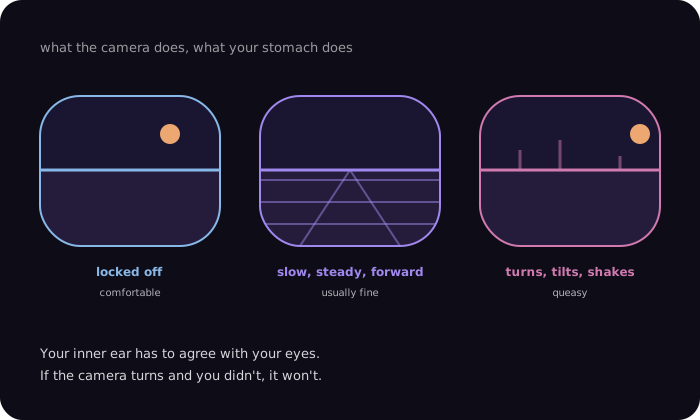
The research backs up what every 360 director learns the hard way. A 2019 trial found that stabilising a moving 360 camera cut sickness. Nokia Bell Labs found sickness rises with how much and how often the camera moves, and that fixed reference points help. So:
- Lock it off whenever you can. A tripod is your friend.
- If you move, move slowly and in a straight line. A smooth dolly or a slow walk forward is usually fine.
- Keep the horizon level. Most cameras do this for you now with gyro data.
- Never turn the camera. Let the viewer turn their own head. That's the whole point.
- Think about height. Put the camera at eye height for whoever you want the viewer to be. Too high and they feel like a giant, too low and they feel like a child.
Where You Stand Is the Shot
In flat film, the frame is the shot. In 360, there's no frame. The shot is where you put the camera, who's near it, and where you want people to look.
You can't cut to a close-up, so you stage things at different distances instead. You can't force anyone to look at something, so you use sound, movement and light to invite them. And you can't hide the crew behind the camera, because there is no behind. They hide behind walls, or they become part of the scene.
The Cameras, in 2026
Consumer 360 cameras are better and cheaper than they've ever been:
- Insta360 X5 (April 2025, $549.99): 8K 360 at 30 frames a second, with lenses you can swap out yourself when you scratch them.
- Insta360 X6 (August 2026): bigger sensors, 8K at 50 frames a second, 10-bit colour.
- GoPro Max 2 (September 2025, $499.99): 8K at 30, swappable lenses, six microphones.
- DJI Osmo 360 ($549.99): DJI's first go at it.
- Canon's dual fisheye lenses for its mirrorless cameras: VR180 in stereo, for people who want to shoot it like cinema.
- Blackmagic URSA Cine Immersive (about $30,000 at launch): the camera behind Apple's Immersive Video, shooting stereo 8K per eye at 90 frames a second. A live-broadcast version was shown at NAB in April 2026.
Most 360 Cameras Make Flat Video Now
Here's a twist. A lot of people buying 360 cameras never watch anything in 360. They film everything at once, then pick the angle afterwards and export a normal flat video for Instagram or TikTok. Insta360 calls it "shoot first, point later".
I don't have sales data on how many, but you can see it in how the cameras are marketed: AI tracking, automatic reframing, an "invisible" selfie stick. It's been good for the hardware, and it means more people than ever are carrying a camera that could make real 360 work.
Where People Watch It
The places to watch 360 have shifted a lot in the last two years.
- YouTube is still the biggest library by far. It's played 8K 360 and 180 on Quest since April 2024, and it now has native apps on Vision Pro and Android XR headsets too.
- Meta's Quest TV removed all user-uploaded videos in 2025 and pointed creators to YouTube. It was renamed Horizon TV in December 2025 and now mostly streams Disney+, Prime and the like, with a curated Immersive tab of 180 and 360.
- Apple Vision Pro has the sharpest immersive video around, in Apple's Immersive Video format. With visionOS 26, Apple opened the format to other creators and added native playback of 180 and 360 footage from GoPro, Insta360 and Canon cameras. In March 2026 it announced a new slate of films from the BBC, Red Bull, CNN and CANAL+.
- Android XR headsets, like Samsung's Galaxy XR, play 180 and 360 in YouTube and convert ordinary videos into 3D.
- Festivals and domes. Venice Immersive, SXSW, Tribeca and the rest still programme 360 work, and touring shows put it in front of people who don't own a headset.
360 Video in VRChat
This is the part I know best. VRChat isn't a video app, but it's become one of the best places to watch 360 with other people, because you're actually there together.
How It Works
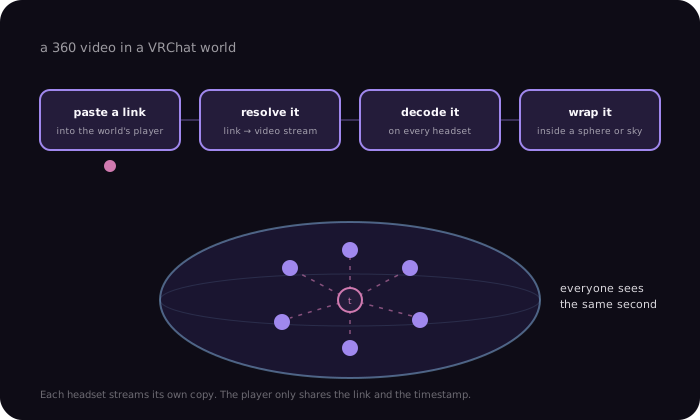
VRChat worlds can include video players. The SDK comes with two, AVPro and Unity's own video player, and there are great community players built on top of them, like ProTV, VizVid, iwaSync and USharpVideo.
When someone pastes a link, the player hands it to VRChat's bundled copy of yt-dlp, which works out the actual video stream behind a YouTube (or other) link. Then every person in the instance downloads and decodes their own copy. The player only shares the link and the timestamp, so everyone stays on the same second.
For 360, you take that video texture and wrap it around the viewer instead of putting it on a screen. There are two ways:
- On the sky. Use a panoramic skybox material and feed it the video. ProTV has a skybox plugin that does this when playback starts, with options for 360, 180, cubemaps and stereo layouts.
- On a sphere. Put a big sphere around the audience with its faces pointing inwards, and give it a panoramic shader. VizVid Pano is a neat one, with presets for 180 and 360 in mono, side-by-side and top-bottom stereo.
For stereo, the shader gives each eye its own half of the frame. That's it.
The Catches
- YouTube resolution. VRChat's players can only play streams that have video and audio in one file. YouTube serves its higher resolutions as separate video and audio streams, so YouTube links often fall back to 360p. On a flat screen that's annoying. Wrapped around your head, it's mush.
- YouTube breakage. Every so often YouTube changes something, playback breaks, and everyone waits for a yt-dlp update. It's been happening since 2024.
- The allowlist. VRChat only plays links from a list of trusted sites unless the viewer turns on "Allow Untrusted URLs" in their settings. Common CDNs aren't on that list.
- Phones. VRChat launched on iOS and Android in October 2025. Android only plays HTTPS links, and codec support varies, so stick to H.264 MP4 if you want it to play everywhere.
- Rate limits. Each person can load a new video link once every five seconds, across all the players in a world.
So for a proper 360 screening: encode an H.264 MP4 at the highest resolution your audience's headsets can decode, add -movflags +faststart so it starts playing before it's fully downloaded, host it somewhere fast, and tell people to allow untrusted URLs. Test it on a Quest before the night. Then test it again.
NB: Quest-friendly worlds play video on the headset itself, so an 8K file that's fine on a PC might stutter on a Quest. Keep a lighter version handy.
Festivals in VRChat
VRChat has been a festival venue since the pandemic.
In 2021, Venice VR Expanded ran a VRChat Worlds Gallery alongside its online programme, with a hub world by VRrOOm, a screening programme and events like a Jean-Michel Jarre concert. That's where I built the preview worlds for Reeducated and The ISS Experience, among others, so VRChat visitors could step into a taste of each piece before opening the full work on a headset.
The Worlds Gallery has been part of Venice Immersive ever since. This year's edition had 26 VRChat worlds, including VoxelKei's Spatialography, a world made of Gaussian splats. I've been the official worldbuilder of the festival's VRChat site since 2024.
Raindance Immersive in London moved into VRChat in 2020 and has kept going, with strands for films shot inside VRChat. A good example is Love's Sorrow by Studio Penrose: a 360 short shot in VRChat, then screened in VRChat, in the Virtual Film Institute's cinema world.
360 Video in the AI Paradigm
Now for the big question. If an AI can make a 360 world from a sentence, what's the point of carrying a camera up a mountain?
Generated 360 Stills
This part is already easy. Blockade Labs launched Skybox AI in February 2023, and it now makes sharp 360 panoramas and HDR skies from a prompt or a sketch. Tencent open-sourced HunyuanWorld 1.0 in July 2025, which makes a 360 panorama and then turns it into layered 3D meshes you can export into a game engine.
Generated 360 Video
Moving 360 is harder, and it's not really solved. A few things exist:
- Veo 3, by accident. In June 2025, people found that adding "360°" to a Google Veo 3 prompt produced mono 360 video. You inject the 360 metadata yourself afterwards. It's not an official feature, and it's low resolution.
- Research models. PanoWan (NeurIPS 2025) adapts an open video model to 360 and deals with the seam where the image wraps round. Skywork's Matrix-3D generates 360 video along a camera path, then rebuilds it as a 3D scene, and its smaller model runs in 12 GB of video memory.
- Perspective to 360. Models like Imagine360 and Argus take a normal flat video and imagine the rest of the sphere around it.
What I couldn't find, as of today, is any major product that sells stereo 360 or VR180 generation. What's out there is mono, low resolution and a few seconds long. That will change. It just hasn't yet.
World Models: Past the Fixed Viewpoint
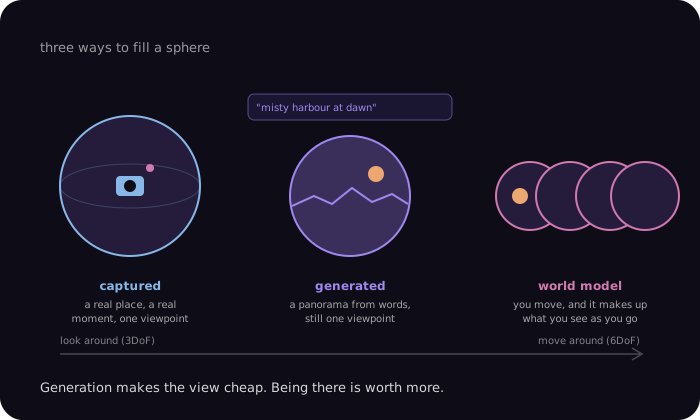
This is the bigger shift. A 360 video is one viewpoint. A world model lets you move.
- Genie 3 from Google DeepMind (August 2025) generates a world you can walk around in real time, at 720p and 24 frames a second, from a text prompt. Google opened it to some subscribers as Project Genie in January 2026, and announced Genie 4, with sound, to testers on 27 October.
- World Labs' Marble (generally available from November 2025) builds a persistent 3D world from text, images or video, and exports it as Gaussian splats, meshes or video.
- Tencent's HY-World 1.5 (December 2025) streams an interactive world from keyboard and mouse input, and it's open.
In other words, the thing 360 video could never do (let you lean in and walk across the room) is exactly what these models are built for. The catch is that they make it up. What you see is a guess at what the world might look like, not a record of what it did look like.
Turning Real 360 Into 6DoF
The more interesting work, for me, goes the other way: using AI to give real footage the depth it never had.
- Depth from one image. Apple's Depth Pro and ByteDance's Depth Anything 3 estimate how far away everything is from a single picture.
- 360 photos to splats. Several research projects in 2025 and 2026 turn one or a few 360 photos into a Gaussian splat scene you can move around in a little.
- Your room, captured. Meta's Hyperscape Capture (September 2025) lets a Quest 3 scan a room into a photoreal splat scene you can walk through.
- Spatial scenes. visionOS 26 uses generative AI and depth to let you move your head around an ordinary photo and see a little way round objects.
That's where I think 360 is heading. Not replaced, but upgraded: real capture, with just enough generated depth that you can lean in.
AI in the Pipeline
AI is already in most 360 cameras whether you notice it or not: noise reduction for low light, automatic horizon levelling, the invisible selfie stick, auto-reframing. Upscaling is trickier. Tools like Topaz can take 6K 360 to 8K, but they don't know the image wraps round, so they can leave a visible line at the seam. Check yours.
So, Is Capture Still Worth It?
I think capture is worth more now, not less.
When anyone can make a gorgeous 360 harbour at dawn from a sentence, the generic view gets cheap. What can't be generated is this harbour, on this morning, with the people who were really there. Journalism, documentary, live events, places that are changing or disappearing. The value moves to having been there.
Reeducated is a useful case here, because it isn't captured footage at all. It's drawn. Its authority comes from the testimony of three men who were held in the camps, and from being completely open about how it was made. That's the bar. Immersive work can be truthful without a camera, as long as it tells you what's real.
The tooling hasn't caught up. Content credentials (the C2PA standard for proving where a picture came from) now cover live and streamed video, but I couldn't find anything specific to 360 or immersive video, and I couldn't find a 360 camera that signs its footage. Until there's a way to prove a 360 video was shot where it says it was, we're relying on trust.
What It's Really For
I keep coming back to 360 because of what it does to your attention. In a headset, there's no frame to look away from and no phone in your hand. You're standing somewhere, and you have to decide where to look.
That's the bit AI can't replace and resolution charts can't measure. A good 360 film puts you in a moment and asks you to actually notice it. The best ones stay with you for a long time.
If you've never tried one, start with the players above. Then put on a headset and watch them properly.
Sources
History and formats:
- Google Cardboard at I/O 2014: https://www.engadget.com/2014/06/25/google-vr-cardboard/
- YouTube 360 launch, March 2015: https://thenextweb.com/news/youtube-now-supports-360-degree-videos-virtual-reality-cat-videos-incoming
- Facebook 360 in News Feed: https://www.engadget.com/2015/09/23/facebook-360-video-news-feed/
- NYT VR and a million Cardboards: https://www.niemanlab.org/2015/10/the-new-york-times-is-sending-out-a-million-google-cardboards-to-go-with-its-upcoming-vr-films/
- Nokia stops OZO: https://www.wareable.com/vr/nokia-to-stop-building-ozo-vr-cameras-5203
- Verizon buys Jaunt's technology: https://www.cnbc.com/2019/09/30/verizon-is-buying-virtual-reality-company-jaunt.html
- Equi-angular cubemaps (Google, 2017): https://blog.google/products/google-vr/bringing-pixels-front-and-center-vr-video/
- YouTube 360 upload requirements: https://support.google.com/youtube/answer/6178631
- YouTube spatial audio: https://support.google.com/youtube/answer/6395969
- Quest 3 and 3S display figures: https://www.meta.com/quest/compare/
- 8K 180 and 360 on Quest 3: https://www.uploadvr.com/youtube-now-supports-8k-180-3d-videos-on-quest-3/
- Quest 3 decoding: https://deovr.com/blog/75 and https://bitmovin.com/best-encoding-settings-meta-vr-360-headsets/
The pieces:
- Clouds Over Sidra: https://en.wikipedia.org/wiki/Clouds_Over_Sidra
- The Displaced: https://uploadvr.com/new-york-times-vr-one-million-google-cardboard/
- Pearl: https://en.wikipedia.org/wiki/Pearl_(2016_film)
- HELP: https://roadtovr.com/behind-scenes-googles-new-live-action-360-short-film-help/
- The People's House: https://www.televisionacademy.com/shows/peoples-house-inside-white-house-barack-and-michelle-obama
- Reeducated at Venice VR Expanded 2021: https://www.labiennale.org/en/cinema/2021/lineup/venice-vr-expanded/reeducated
- Reeducated at SXSW: https://pulitzercenter.org/stories/reeducated-inside-xinjiangs-secret-detention-camps
- Reeducated's Emmy: https://alumni.risd.edu/news-events/alumni-win-emmy-vr-documentary
- Reeducated's Peabody: https://peabodyawards.com/award-profile/reeducated/
- Space Explorers: The ISS Experience: https://en.wikipedia.org/wiki/Space_Explorers:_The_ISS_Experience
- The ISS cameras (Z CAM): https://www.z-cam.com/nasa-iss-experience-captured-with-z-cam-v1-pro/
- The Space Camera and the spacewalk: https://www.provideocoalition.com/the-space-camera-the-first-ever-spacewalk-filmed-in-cinematic-vr/ and https://issnationallab.org/?p=35709
- The ISS Experience's Emmy: https://www.televisionacademy.com/shows/space-explorers-iss-experience
- THE INFINITE: https://issnationallab.org/?p=35589
- ISS episodes 1 and 2 at Venice 2021: https://www.labiennale.org/en/cinema/2021/lineup/venice-vr-expanded/space-explorers-iss-experience-ep-1-adapt-ep-2-advance
Making and watching:
- Stabilisation and sickness (Litleskare and Calogiuri, 2019): https://www.frontiersin.org/articles/10.3389/fpsyg.2019.02436
- Camera motion and sickness (Nokia Bell Labs): https://www.nokia.com/bell-labs/publications-and-media/publications/towards-systematic-analysis-of-cybersickness-in-high-motion-omnidirectional-video
- Insta360 X5: https://old.imaging-resource.com/news/2025/04/22/insta360-x5-brings-8k-video-and-ai-smarts-to-the-360-degree-action-cam-game
- Insta360 X6: https://www.newsshooter.com/2026/08/12/insta360-x6-flagship-8k-360-camera/
- GoPro Max 2: https://old.imaging-resource.com/news/2025/09/23/gopro-max-2-launched-price-8k-360-video-features-and-where-to-buy
- Canon dual fisheye lenses: https://www.newsshooter.com/2024/06/10/canon-announced-the-rf-s-3-9mm-f3-5-stm-dual-fisheye-rf-s-7-8mm-f4-stm-dual-lenses/
- Blackmagic URSA Cine Immersive: https://appleinsider.com/articles/24/12/16/blackmagics-new-camera-for-apple-vision-pro-content-has-a-hefty-29995-price-tag and https://petapixel.com/2026/04/13/blackmagics-new-camera-is-the-worlds-first-for-immersive-live-broadcasting/
- Shoot first, point later: https://www.insta360.com/blog/tips/how-to-edit-and-reframe-360.html
- Quest TV overhaul: https://www.uploadvr.com/meta-overhauls-quest-tv-app-to-be-hub-for-streaming-content/ and https://dataconomy.com/2025/12/16/meta-launches-disney-on-quest-headsets/
- visionOS 26 and 180/360 playback: https://support.apple.com/en-gb/125014
- Apple Immersive for third-party creators: https://www.svconline.com/proav-today/apple-is-making-its-immersive-video-format-available-to-third-party-creators
- Apple's March 2026 immersive slate: https://www.iclarified.com/98569/apple-announces-new-slate-of-immersive-films-for-vision-pro
- Galaxy XR and YouTube: https://blog.google/products/android/samsung-galaxy-xr
VRChat:
- VRChat video players: https://creators.vrchat.com/worlds/udon/video-players/
- VRChat URL allowlist: https://creators.vrchat.com/worlds/udon/video-players/www-whitelist
- VRChat and yt-dlp: https://help.vrchat.com/hc/en-us/articles/1500002378742
- YouTube resolution in VRChat players (community thread, April 2026): https://ask.vrchat.com/t/avpro-player-vizvid-plays-low-resolution-yt-videos/48357/4
- ProTV: https://protv.dev
- VizVid Pano: https://hackmd.io/@JLChnToZ/vizvid-pano
- VRChat on iOS and Android: https://www.uploadvr.com/vrchat-now-available-on-iphone-ipad-flatscreen-android/
- Venice VR Expanded 2021 in VRChat: https://www.labiennale.org/en/cinema/2021/screening-programme and https://voicesofvr.com/1001-sneak-peak-of-venice-vr-expanded-2021-new-vrchat-worlds-gallery/
- Venice Immersive 2026 selection: https://www.labiennale.org/en/news/venice-immersive-selection-and-competition-announced-0 and https://radiancefields.com/voxelkei-s-spatialography-selected-for-venice-immersive-2026-best-of-worlds
- Raindance Immersive: https://uploadvr.com/raindance-immersive-2024-vrchat-festival and https://www.raindanceimmersive.com/loves-sorrow/
AI:
- Skybox AI: https://www.blockadelabs.com/ and https://www.cgchannel.com/2024/04/blockade-labs-launches-skybox-ai-2
- HunyuanWorld 1.0: https://github.com/Tencent-Hunyuan/HunyuanWorld-1.0
- Veo 3 and 360: https://gizmodo.com/bad-news-googles-veo-3-can-make-vr-slop-too-2000612552
- PanoWan: https://neurips.cc/virtual/2025/poster/119701
- Matrix-3D: https://github.com/SkyworkAI/Matrix-3D
- Genie 3 and Project Genie: https://en.wikipedia.org/wiki/Genie_(world_model)
- Genie 4: https://northeasttimes.com/2026/10/27/google-deepmind-opens-genie-4-preview-to-testers-with-audio-and-two-minute/
- World Labs Marble: https://www.worldlabs.ai/blog/marble-world-model
- HY-World 1.5: https://3d-models.hunyuan.tencent.com/world/world1_5/HYWorld_1.5_Tech_Report.pdf
- Depth Pro: https://github.com/apple/ml-depth-pro
- Depth Anything 3: https://pypi.org/project/depth-anything-3/
- One 360 photo to a 6DoF scene: https://researchportal.bath.ac.uk/en/publications/360-3d-photos-from-a-single-360-input-image/
- Meta Hyperscape Capture: https://uploadvr.com/meta-horizon-hyperscape-photorealistic-scene-capture-quest-3
- visionOS 26 spatial scenes: https://www.businesswire.com/news/home/20250609148562/en/visionOS-26-introduces-powerful-new-spatial-experiences-for-Apple-Vision-Pro
- Insta360 X5's AI features: https://www.bikeradar.com/news/insta360-x5
- Upscaling and the 360 seam: https://news.lecce360.com/?p=57169
- Content credentials (C2PA 2.3): https://c2pa.org/the-c2pa-launches-content-credentials-2-3-and-celebrates-5-years-of-impact-across-the-digital-ecosystem/